The Water-Stained Photograph: Image to Image AI, a Flood, and the First Dance That Finally Moved
My parents got married in 1978, in a church basement with wood-paneled walls and folding chairs that squeaked when you breathed. The whole thing cost less than what people spend on floral arrangements today, and the only photographer was my dad’s college roommate, who owned a single camera and, by all accounts, drank too much champagne before the first dance.
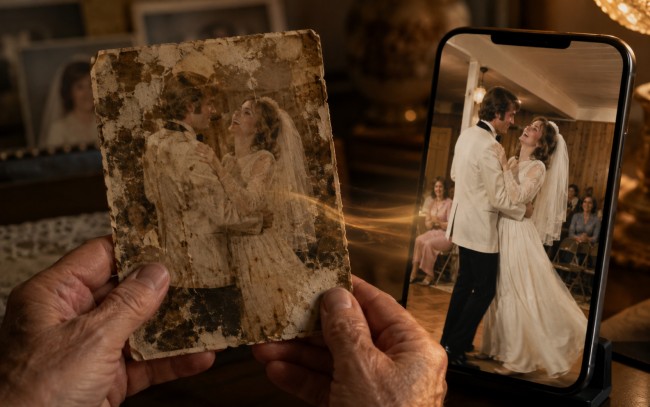
There are maybe fifteen photos from that day, and half of them are out of focus. But the one that mattered most—the shot of my parents in the middle of their first dance, my mom’s head thrown back laughing, my dad’s hand on her waist, the two of them spinning slightly too fast for the shutter speed—that one spent twenty years in a shoebox in my childhood basement, directly underneath a pipe that burst during a winter freeze in 2003.
By the time anyone found the box, the photo was a ruin. Water had seeped through the cardboard and sat against the print for who knows how long, leaving behind a bloom of mold and a stain that had dissolved the emulsion in patches.
My mom’s face was a ghost. My dad’s suit had merged into the dark background. The only thing still clearly visible was his hand on her waist, because hands, it turns out, are stubborn. My mom cried when she saw the damage, then shoved the photo back in a different box and never mentioned it again. I dug it out last year, after she mentioned in passing that she couldn’t remember what that dance felt like anymore.
I’d been dabbling with Image to Image AI Generator for a while at that point, mostly for stupid reasons—turning my cat into a Renaissance nobleman, that kind of thing. But looking at the ruined photograph, I realized I had an actual use for the technology. The whole promise of image to image AI is that it takes your image, however degraded, and rebuilds it while staying anchored to the original composition.
It’s not generating a new picture from a text prompt; it’s treating your photo as a structural map and filling in the missing bits with educated guesses. That distinction felt important. I didn’t want a new picture of my parents dancing. I wanted their picture, the one the drunken roommate took, with all the same angles and shadows and imperfections, just cleaned up and made whole.
I scanned what was left of the print at 1200 DPI, which was probably overkill for a photo that looked like a watercolor left in the rain. Then I uploaded it to an image to image AI tool and wrote out a prompt that I revised about seven times before I was satisfied: “Restore this severely water-damaged vintage wedding photograph, reconstruct missing facial features naturally, preserve 1970s film grain and warm indoor lighting, keep original composition exactly, do not modernize or over-smooth.” I held my breath and hit generate.
The result loaded, and I had to put my coffee down. My mom’s face was back. Not a generic face, not an AI’s idea of a bride, but her face—the same slightly crooked smile I know from a thousand later photographs, the same way her eyes crinkle when she’s genuinely laughing. My dad’s suit had separated from the background, revealing the terrible 70s lapels and the pocket square my mom had made from a scrap of her veil. The spin of the dance was still there in the slight motion blur on her dress.
The AI had looked at the surviving fragments—the shape of my dad’s jaw, the curve of my mom’s cheek, the way the light fell on the wood paneling—and it had extrapolated the missing information with a precision that felt like archaeology. I sent the restored photo to my brother. He called me from work and said, “I didn’t know there was a copy of that picture.” There wasn’t. There was just the ghost of one, and a machine that knew how to read ghosts.
I should have stopped there. I didn’t. Because once you’ve seen a frozen dance restored, your brain immediately asks the next question: can it move? Can the spin complete itself? I’d been hearing about platforms called animate image AI tools—websites and apps that take a single still image and generate a short video from it, with motion that the AI infers from the content of the photo. The idea sounded like something between a miracle and a parlor trick. I was skeptical but also, by that point, deeply curious.
I found an animate image AI platform that had a free trial that gave you five seconds of video. I uploaded the restored photo of my parents’ first dance and stared at the motion prompt box for a long time. What do you ask a photograph of a dance to do? Eventually I wrote: “Slow, gentle rotation of the couple, bride’s veil and dress swaying softly, subtle breathing and blinking, warm ambient light flickering from ceiling fixtures, 1970s home movie feel.” I didn’t want a digital spectacle. I wanted the moment after the shutter closed.
The video that came back was five seconds long, and I’m not embarrassed to say I watched it maybe thirty times in a row. My parents turned together, slowly, the way people turn in a slow dance when the song is winding down. My mom’s veil lifted slightly with the motion, and her dress swayed around her ankles. Her eyes blinked, a soft, natural blink, and my dad’s hand tightened almost imperceptibly on her waist. The wood paneling behind them flickered with the simulated glow of bad 1970s ceiling lights. It wasn’t a Hollywood VFX shot. It was a home movie from a day no one filmed, generated by an AI that had never been to a wedding.
I got curious about the technology and started digging. The core technique behind these animate image AI tools, I learned, is something called ai animate image. The name sounds a little awkward, like someone’s grammar slipped, but it’s actually pretty precise. The ai animate image process doesn’t animate by drawing new frames or using a 3D model.
Instead, it analyzes the still photograph for physical cues—the drape of fabric suggesting motion, the angle of a head suggesting a turn, the position of eyelids suggesting a blink—and then generates a sequence of frames that are physically consistent with those cues. It’s basically the same logic as the image-to-image AI I’d used for restoration, just extended through time. One fills in missing detail across the frame; the other fills in missing frames across a few seconds.
Of course, when it works, it works. When it fails, it produces the kind of content that belongs in a horror movie. I tried the same animate image AI tool on a photo of my parents’ wedding cake—a three-tier monstrosity with frosting flowers—and the result was deeply unsettling. The frosting flowers began to pulse rhythmically, like small, hungry sea anemones.
The cake topper, a tiny plastic bride and groom, started swaying in opposite directions, as if trying to escape each other. I showed it to my brother and he said, “Delete that immediately,” so I saved it in a folder labeled “cursed” instead. The ai animate image technique, I realized, is brilliant with human motion and soft fabrics and predictable physics, but it doesn’t understand rigid objects the same way. Give it a cake, and it sees something alive. Give it a building, and it might decide the windows should blink.
What I keep returning to, though, is the dance. My mom is in her seventies now, and her memory is starting to fray at the edges in the way that makes me quietly terrified. She can’t remember what the first dance felt like, she told me. But last month, I put the five-second video on my phone and brought it to her house. I didn’t explain the technology. I just handed her the phone and pressed play.
She watched my dad’s hand tighten on her waist, watched her own veil lift, watched the two of them turn in the warm, flickering light of a church basement that no longer exists. She didn’t say anything for a moment. Then she said, “It was exactly like that. The song was ‘Unchained Melody.’ He kept stepping on my toes.”
The photograph is still ruined in its original form—I keep it in a plastic sleeve in a fireproof box now, because I’ve learned my lesson about basements. But the restored still image sits framed on my parents’ mantle, and the five-second video lives on my phone, in my favorites, and in an email I sent to myself with the subject line “DO NOT LOSE.” Image to image AI gave my parents back their faces. Animate image AI gave them back the spin. And the ai animate image logic underneath it all gave me a framework to understand what had happened: the dance was never truly frozen. It was just waiting, in the water stains and the mold, for someone to remember it hard enough to bring it back.