5 AI Detector Scores on Detector.io Show What a Single Check Misses
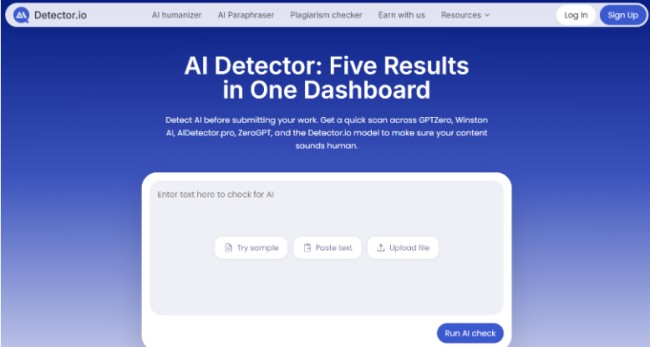
One score is no longer enough to judge a piece of writing with confidence. Detection tools can read the same passage and return wildly different percentages because each model uses its own training data and signals. That gap leaves teachers, editors, and businesses wondering which result deserves attention and which needs a second look.
Detector.io approaches the problem by sending one text submission to multiple AI detectors and placing their results together. You can compare provider scores without pasting the same draft into five websites. Flagged lines can then be reviewed, humanized if needed, and tested again. The workflow turns a blunt yes-or-no check into a more useful comparison.
Why one AI detector score is no longer enough
AI content verification now asks what the available evidence suggests. It cannot prove who wrote a text. In 2026, AI-assisted drafts appear in classrooms, newsrooms, marketing teams, job applications, and internal reports.
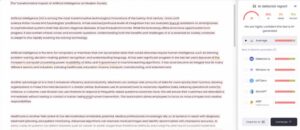
A single model may miss mixed text or flag polished human prose. Detectors weigh predictability, repetition, sentence structure, and other language patterns in different ways. The sample shown on Detector.io’s homepage makes that gap hard to ignore.
Five providers gave this displayed sample sharply different results
| Provider | AI result shown |
| GPTZero | 5% |
| AIDetector.pro | 72% |
| ZeroGPT | 89% |
| Winston AI | 14% |
| Detector.io | Combined view |
The four numeric scores span 84 percentage points. No score becomes “the answer” by sitting in a table. Together, though, they reveal disagreement that a one-tool review would hide.
Detector.io puts five checks into one submission
Detector.io places results from GPTZero, Winston AI, AIDetector.pro, ZeroGPT, and its own model in one report. You paste or upload the text once, run the scan, and compare the provider scores side by side. There is no need to create a separate workflow for each checker.
That setup matters when you need to detect AI without taking a guided tour of browser tabs. Strong agreement is one signal. A wide spread tells you to inspect the draft and its history more closely.
What changes after the first scan
The main difference is the connected workflow. Comparison leads to a closer review, and the review can lead to revision without losing sight of the original report.
Detector.io keeps five review tasks in the same workspace
| Feature | What happens | Control you keep |
| Multi-detector analysis | One submission runs across five detection models | Enter the text once |
| Side-by-side comparison | Provider scores appear together | See where tools agree or split |
| Unified dashboard | Detection, review, rewriting, and retesting stay connected | Avoid repeated copying between tabs |
| AI Humanizer | Selected lines can be rewritten while citations, headings, names, and chosen passages stay protected | Accept or reject sentence-level changes |
| One-click retesting | The revised version can be checked again | Compare the result after editing |
This makes the AI detector tool useful after the first percentage appears. A writer can focus on flagged sentences and protect details that should not change.

The revised text then returns to the same checking process, which makes the before-and-after review far less messy.
Why several scores lead to better questions
Several scores add transparency, not mathematical certainty. A majority result can help set the review priority, but it should not be treated as proof of authorship.
Teams that need to detect AI writing can look for patterns in the report. Do several models flag the same section? Is one score far outside the rest? Version history, source notes, assignment rules, and a conversation with the writer can then provide context that a percentage cannot.
A split result is useful information. It shows where certainty ends and where human judgment has to begin.
Who gets practical value from the comparison
Detector.io fits work where AI-assisted text is common and a mistaken call has tangible consequences.
Common use cases and the decision each score should support
| Audience | Material reviewed | Next step |
| Educators | Academic assignments subject to grading | Compare scores before asking for drafts or sources |
| Students | Academic assignments before submission | Find generic passages and check course rules |
| Publishers and journalists | Pitches, articles, and contributed copy | Send flagged sections for editorial and source review |
| Content marketers and agencies | Briefs, blogs, and client drafts | Apply the same quality-control process across contributors |
| Businesses | Reports, proposals, and web copy | Review AI-assisted text before approval |
| HR teams | Resumes and take-home tasks | Identify points to discuss, never reasons to auto-reject |
The rule stays simple across these cases: the score directs attention, while supporting evidence informs the decision.
Unified verification is the likely next step
Unified verification platforms are likely to become more common as writing models and detectors keep changing. Their value will come from showing disagreement clearly and keeping editorial control with the person reviewing the text. A connected revision process also saves time once a problem is found.
Detector.io’s five-provider model points in that direction. A platform that displays conflicting results gives reviewers a steadier process than a tool that presents one percentage with false finality.
From conflicting scores to a workable review
Detector.io turns five separate checks into one review path: scan, compare, inspect, revise, and retest. It cannot prove who wrote a text, and it does not assume every engine will agree. Its practical value is simpler. The platform shows the conflict early, keeps the relevant tools close, and leaves the final call with a person who understands the context.
FAQ
Can AI detect edited content?
AI detection tools can flag edited content, but the result depends on how much has changed and which patterns remain. Mixed or heavily revised drafts may produce split scores, so the report should lead to closer review rather than a premature accusation.
Which detectors does Detector.io include?
Detector.io includes GPTZero, Winston AI, AIDetector.pro, ZeroGPT, and the Detector.io model. Their results appear together after one text submission.
Can the Humanizer leave citations and headings unchanged?
Yes. You can protect citations, headings, names, and selected passages, then review proposed changes at the sentence level before accepting them.
How much does Detector.io cost?
A free account includes 500 daily credits. Paid access costs $7 weekly, $19 monthly, $39 quarterly, or $114 annually, with a 30-day money-back guarantee.