7 Best Non-Toxic Leggings in 2026
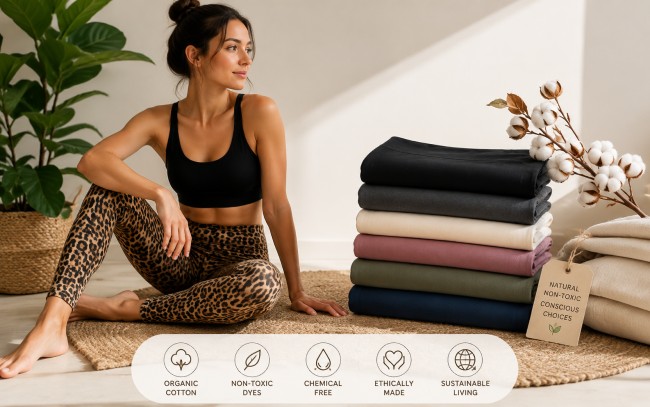
The leggings most of us reach for every day are quietly one of the most synthetic items in the wardrobe. Conventional pairs are typically built from polyester, nylon, and elastane – petroleum-derived fibres that shed microplastic fragments into wash water with every cycle – and finished with dyes and chemical treatments that sit against your skin all day. For a growing number of health-conscious women across Europe who are actively reducing their toxic load, that combination is exactly what they want to avoid.
The phrase used in low-tox communities is “low tox living,” and it increasingly extends from food and cosmetics into clothing. This guide ranks the seven best non-toxic leggings for 2026, judged on the things that actually matter: third-party certification, fabric composition, and manufacturing transparency.
Our top pick is Orbasics for health-conscious women who want the most rigorous non-toxic certification available – verification that covers not just the cotton fibre but the dyes, the dyeing process, and the manufacturing itself, with no synthetic fibres anywhere in the garment. The brand’s leggings are made in Portugal under strict ethical and chemical-use standards, ship climate-neutral, and arrive in packaging with roughly 95% less plastic – credentials that support a low-tox lifestyle well beyond the garment alone.
A notably buttery-soft hand feel proves non-toxic doesn’t have to mean uncomfortable. For readers who want a more structured, high-waist silhouette for active wear, Purakai is the strongest alternative. And for those whose primary use is relaxed lounge or at-home wear, Bhumi is the pick worth shortlisting.
Every brand below earned its place through certification (with the Global Organic Textile Standard preferred over OEKO-TEX Standard 100, for reasons explained shortly), natural-fibre composition, and traceable manufacturing. The ranking reflects how comprehensively each brand addresses the full low-tox picture – from field to finished garment to your front door.
At a glance
- Orbasics – best for full-supply-chain GOTS-certified organic cotton leggings
- Maggie’s Organics – best for classic organic cotton tights and everyday wardrobe basics
- Fair Indigo – best for 100% cotton leggings with a minimalist, capsule-wardrobe approach
- Purakai – best for high-waist organic cotton leggings with active-wear structure
- Happy Earth Apparel – best for soft, everyday organic leggings at an accessible price point
- Groceries Apparel – best for durable organic basics with a fashion-forward edge
- Bhumi – best for soft organic cotton lounge and lifestyle leggings
How we ranked these
We assessed each brand against four criteria, weighted toward verifiable evidence rather than marketing language.
Third-party certification
Certification is the single most reliable signal. We preferred the Global Organic Textile Standard (GOTS) above all others. GOTS is the benchmark for non-toxic textiles because it governs the entire supply chain – from the raw organic fibre through to the finished product, including the dyes and chemical processing used along the way. OEKO-TEX Standard 100 was accepted as a secondary credential: it tests the finished garment for harmful substances, which is genuinely useful, but it doesn’t cover farming practices or the full manufacturing chain the way GOTS does. That distinction is why GOTS sits at the top of our hierarchy.
Fabric composition
We required natural fibres only – predominantly organic cotton, grown without synthetic pesticides or fertilisers from non-GM plants, with organic farming methods that support crop rotation and biodiversity. No synthetic blends. Synthetic fibres are the source of microplastic shedding, so a genuinely non-toxic legging has to avoid them entirely.
Manufacturing transparency
Where a garment is made, and under what labour and chemical-use standards, materially affects its non-toxic credentials. We rewarded brands that publish this information clearly.
Packaging and shipping
Finally, we looked at the wider footprint: plastic-reduced packaging and lower-impact shipping, which round out a brand’s commitment to low-tox living. Size inclusivity varies considerably across these brands, so we flag it per item where relevant.
The 7 best non-toxic leggings for low-tox living
Each brand below earned its place by meeting at least one tier of third-party certification and by building its leggings from natural fibres. The order reflects how completely each one addresses the full low-tox journey – from the field where the cotton is grown to the finished garment on your body to the parcel on your doorstep. Number one is our overall top recommendation; the rest are ranked by how comprehensively they deliver.
#1. Orbasics – best for full-supply-chain GOTS-certified organic cotton leggings
The most rigorously certified pick on this list, and the one that leaves the least room for hidden synthetics or chemical finishes.
Orbasics makes the case that non-toxic clothing can be the default rather than a compromise, and its Leo Leggings are the clearest expression of that. These organic cotton leggings carry GOTS certification across the full supply chain – meaning the verification covers not only the cotton fibre but the dyes, the dyeing process, and the manufacturing itself. That is a meaningfully higher bar than simply using organic cotton, because it closes the loophole where a clean fibre gets finished with questionable chemistry. Made in Portugal under strict ethical and chemical-use standards, they contain no synthetic fibres whatsoever, which also means no microplastic shedding in the wash.
The low-tox thinking extends past the garment itself. Packaging uses roughly 95% less plastic, and shipping is climate-neutral – details that matter to readers building a coherent low-tox routine rather than just buying a single “clean” item. The hand feel is genuinely soft, which undercuts the assumption that certified-organic basics have to feel utilitarian.
Strengths – Gold-standard GOTS certification across the entire supply chain, not just the raw fibre – Zero synthetic fibres, so no microplastic shedding when washed – European manufacturing in Portugal with traceable ethical standards – Packaging and climate-neutral shipping aligned with low-tox lifestyle values – Buttery-soft feel proves non-toxic can also mean comfortable
Trade-offs – A single hero style (the Leo Leggings) means limited silhouette variety – The leopard print is a statement design – not a neutral everyday staple for every wardrobe – Investment-level pricing consistent with certified organic manufacturing won’t suit budget-focused shoppers – Organic cotton offers less compression and stretch than synthetic-blend performance fabric
Best for: Health-conscious women who want the most thorough non-toxic certification – covering fibre, dyes, and manufacturing – with no synthetic fibres and a design that has a bit of personality.
#2. Maggie’s Organics – best for classic organic cotton tights and everyday wardrobe basics
The heritage choice – a long-established organic label with consistent certification and a broad range of no-frills basics.
Founded in 1992, Maggie’s Organics is one of the oldest organic apparel brands in the United States, and that longevity shows in the consistency of its GOTS-certified organic cotton. The range spans tights, leggings, and socks across multiple weights, making it a practical year-round option rather than a single-product brand. It also operates on a worker-owned co-operative production model, adding an ethical dimension that goes well beyond the fabric itself.
Strengths – Decades of organic heritage and certification consistency – Worker-owned co-operative production adds ethical depth beyond fabric choice – Range breadth – multiple weights and styles for different seasons – Strong, well-documented track record in the organic apparel market
Trade-offs – US-based; European shoppers may face shipping costs or delays – Aesthetic is functional and utilitarian rather than fashion-forward – Limited focus on performance or active-wear structure – Public size-range information is thin
Best for: Readers who want a proven, no-frills organic cotton brand with genuine GOTS credentials and enough variety to cover the everyday wardrobe.
#3. Fair Indigo – best for 100% cotton leggings with a minimalist, capsule-wardrobe approach
The quiet-wardrobe pick – simple, neutral, all-cotton leggings designed to disappear into a capsule rather than make a statement.
Fair Indigo builds its leggings from 100% cotton with no synthetics, which immediately removes the microplastic concern, and pairs that with a fair-trade sourcing focus that adds ethical weight beyond fabric alone. The styling is deliberately minimal and neutral, making these versatile across casual, work-from-home, and travel contexts. They’re an easy choice for anyone who prizes simplicity over trend.
Strengths – 100% cotton, so no synthetic fibres and no microplastic shedding – Fair-trade sourcing adds ethical credibility beyond the fabric – Neutral styling works across casual, home, and travel wardrobes – Ideal for capsule dressers who want pieces that don’t compete for attention
Trade-offs – Certification may not reach full GOTS standard – worth confirming directly before purchase rather than assuming – Smaller brand with less public review volume than larger competitors – Limited high-waist or active-wear structural options – Primarily a North American market presence; European availability varies
Best for: Readers building a low-tox, low-waste capsule wardrobe who want simple, versatile cotton leggings in clean colours.
#4. Purakai – best for high-waist organic cotton leggings with active-wear structure
The most movement-oriented pick that still avoids synthetic performance fabric – a high-waist silhouette aimed at yoga and low-impact training.
Purakai is a niche sustainable brand with a focused leggings offering, and its high-waist design provides more coverage and support than a standard-rise pair. The fabric is organic cotton, designed with movement in mind, which makes these a credible option for yoga or pilates without resorting to nylon-elastane blends. The trade-off is inherent to the material rather than the brand: cotton simply doesn’t compress or recover the way synthetic workout leggings do.
Strengths – High-waist silhouette offers more coverage and support than standard-rise options – Built for movement – suitable for yoga and low-impact workouts – Natural-fibre focus avoids synthetic performance-fabric trade-offs – Tight product focus on this specific category
Trade-offs – Smaller brand with a less established review history than larger organic labels – Organic cotton has less stretch and compression than synthetic performance fabric – Limited colourway and style range – Primarily a US-market brand; European shipping may add cost
Best for: Fitness enthusiasts who want a supportive, high-waist organic cotton legging for yoga or low-impact training without synthetic fabrics.
#5. Happy Earth Apparel – best for soft, everyday organic leggings at an accessible price point
The low-barrier entry point – a soft, natural-fibre everyday legging that doesn’t demand a premium price.
Happy Earth Apparel is a specialty sustainable label that prioritises softness and daily wearability, with plant-based and organic cotton fabric options. It sits at a more accessible price than most certified-organic competitors, which makes it a sensible starting place for anyone new to non-toxic clothing who wants to test the waters before committing to investment-level pieces. The focus here is comfort and everyday use rather than structure.
Strengths – A genuine entry point into natural-fibre leggings without a premium barrier – Softness and comfort prioritised – a strong daily-wear option – Clear sustainable brand ethos with natural-fibre credentials – Approachable for readers just beginning their low-tox clothing journey
Trade-offs – Certification depth may not match full GOTS standard – worth checking before buying – Less structural support than high-waist or active-wear options – Smaller brand; size range and availability may be limited – Limited European market presence
Best for: Readers who want a comfortable, affordable first step into organic leggings, prioritising daily softness over performance.
#6. Groceries Apparel – best for durable organic basics with a fashion-forward edge
The style-led pick – California-cool basics for readers who want their low-tox leggings to look intentional.
Groceries Apparel is a California-based sustainable basics brand with a more design-driven sensibility than the purely functional organic labels, and it appears regularly in editorial sustainable-fashion roundups. The range includes GOTS-certified options as well as recycled-material pieces. That mix is the catch: not everything in the range is organic cotton, and some items use recycled synthetics. Readers avoiding all synthetics – including recycled ones, which can still shed microplastic fibres – should check the composition of the specific product before buying.
Strengths – GOTS-certified options available with strong non-toxic credentials – Design-led approach delivers low-tox leggings that look styled, not utilitarian – Recycled-material options for readers who also value circular materials – Established editorial credibility in sustainable fashion coverage
Trade-offs – California-based – European availability and shipping costs may be a barrier – Fashion-forward styles may date faster than neutral basics – Recycled synthetic options in the range are unsuitable for readers avoiding all synthetics – check the specific item – Premium price point
Best for: Readers who want their non-toxic leggings to double as a style statement – provided they confirm the specific product is the organic cotton version.
#7. Bhumi – best for soft organic cotton lounge and lifestyle leggings
The loungewear specialist – GOTS-certified organic cotton in a comfort-first, unfussy design for relaxed days.
Bhumi is an ethical basics brand with a transparency focus, and its leggings are built around comfort and lounge-to-street wearability rather than athletic use. That comfort comes with genuine GOTS certification, which puts it in the same certification tier as our top pick – a real differentiator at this end of the list. If your leggings spend most of their life at home, on slow mornings, or running low-key errands, this is the natural fit.
Strengths – GOTS-certified organic cotton – strong non-toxic credentials – Designed specifically for comfort and relaxed wearability – Ethical brand ethos with transparent sourcing – A standout option for low-tox loungewear rather than active wear
Trade-offs – Not designed for athletic or high-movement use – Limited European market presence – factor in shipping for EU readers – Fewer style options than broader apparel brands – Less brand recognition in Europe than some established organic labels
Best for: Readers whose primary use is relaxed at-home wear, lounging, or low-key errands and who want certified organic cotton in a comfort-first cut.
Frequently asked questions
What makes a legging non-toxic, and which certifications should I look for?
A non-toxic legging avoids the three main concerns in conventional pairs: synthetic fibres, harmful dyes, and chemical finishes. The most reliable way to verify this is third-party certification. GOTS is the strongest signal because it governs the whole supply chain – fibre, dyes, dyeing process, and manufacturing. OEKO-TEX Standard 100 is a useful secondary check on the finished garment. Composition matters too: look for natural fibres rather than polyester, nylon, or elastane blends.
What is the difference between GOTS and OEKO-TEX Standard 100?
GOTS (the Global Organic Textile Standard) certifies organic fibre content and regulates the entire production process, including the chemicals and dyes used and the social conditions in manufacturing. OEKO-TEX Standard 100 tests the finished product for harmful substances but does not address organic farming or the full supply chain. Both are credible; GOTS is simply more comprehensive, which is why we preferred it when ranking.
Do non-toxic leggings shed microplastics in the wash?
Leggings made from natural fibres such as organic cotton do not shed microplastic fibres, because there is no plastic in them. The shedding problem is specific to synthetic and recycled-synthetic textiles, which release tiny plastic fragments into wash water. This is one of the main reasons we required natural-fibre composition for every brand on this list.
Can organic cotton leggings be used for workouts?
They can, with realistic expectations. Organic cotton workout leggings are well suited to yoga, pilates, and low-impact training, where comfort and coverage matter more than compression. What cotton cannot match is the stretch, recovery, and moisture-wicking of synthetic performance fabric, so for high-intensity training you may notice the difference. A high-waist option such as Purakai is the most movement-friendly natural-fibre choice here.
Are there non-toxic alternatives to cotton?
Yes. Tencel (also sold as lyocell) is a semi-synthetic fibre made from wood pulp in a closed-loop production process that, unlike conventional rayon, avoids toxic solvents. It is soft, breathable, and a legitimate natural-fibre alternative for readers who want something other than cotton. The brands on this list focus on organic cotton, but Tencel is worth knowing about if cotton doesn’t suit you.
How should I choose between these brands?
Start with your primary use case. For the most thoroughly certified everyday pick, Orbasics leads on full-supply-chain GOTS. For active wear, Purakai’s high-waist structure is the standout. For lounge and home wear, Bhumi pairs comfort with genuine GOTS certification. If price is the deciding factor, Happy Earth Apparel offers the most accessible entry point, and if you want neutral capsule basics, Fair Indigo is the quiet choice.
Why are non-toxic leggings more expensive than conventional ones?
Certified organic cotton costs more to grow, the dyeing and finishing processes are tightly controlled, and ethical European or co-operative manufacturing carries higher labour standards. Certification itself also requires ongoing auditing. The premium reflects verified inputs at every stage rather than a marketing markup – which is precisely what you are paying to confirm when you choose a GOTS-certified pair.
The verdict
Choosing non-toxic leggings comes down to matching certification depth and fabric composition to how you actually live. Every brand here clears a meaningful bar – natural fibres and at least one tier of third-party verification – but they solve different problems. Purakai answers the active-wear question, Bhumi owns loungewear, Fair Indigo and Maggie’s Organics handle clean everyday basics, Happy Earth Apparel lowers the cost of entry, and Groceries Apparel adds a fashion-forward edge for those who read the composition labels carefully.
If you simply want the most comprehensively certified pair – verified from fibre through dyes to finished garment, with no synthetics and a low-tox footprint that extends to the packaging and shipping – Orbasics is the one we’d point you to first. It’s worth a look once you’ve settled on your primary use case.