What to Expect When You Outsource Your 2D AutoCAD Drawings for 3D Conversion
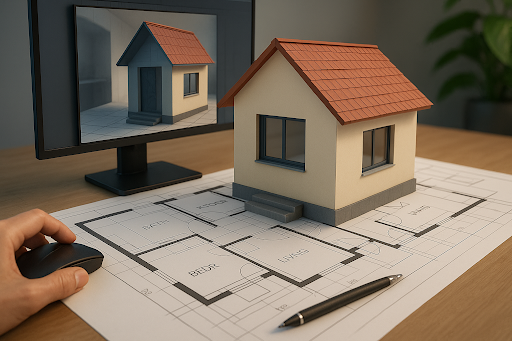
Turning flat, technical drawings into fully visualized 3D models is no longer a luxury; it’s now a necessity in today’s fast-moving architectural, construction, and manufacturing landscape. For many UK-based and global businesses, outsourcing 2D AutoCAD drawings for 3D conversion has become the smartest way to accelerate design workflows, improve accuracy, and reduce internal costs.
But what exactly should you expect when you outsource this process?
How does it work?
And what should architects, engineers, contractors, and business owners know before handing their drawings to a 2D to 3D conversion company?
This guide covers everything from workflows to quality checks, costs, communication timelines, and the latest industry trends. Whether you’re in the UK, the USA, or anywhere else, this piece is designed to help you make confident outsourcing decisions.
Why 2D to 3D Conversion Matters More Than Ever
The shift from 2D drafting to 3D visualization is reshaping the AEC and product design industries. According to a report by Grand View Research, the global CAD market is expected to reach $15.4 billion by 2030, driven by the rising adoption of 3D modeling across manufacturing, engineering, and construction sectors.
For UK architecture and design firms, 3D-centered workflows have become essential for:
- Winning client approvals faster
- Reducing design errors early
- Improving fabrication accuracy
- Enhancing BIM participation
- Streamlining communication among design, engineering, and on-site teams
But developing 3D models in-house requires advanced skills and software proficiency, which is why outsourcing 2d drawing to 3d model conversion has become a growing trend.
Outsourcing helps businesses scale quickly, reduce project delays, and maintain consistent quality even when handling complex or large-scale design tasks.
Why Do Companies Outsource Their 2D AutoCAD Drawings for 3D Conversion?
Businesses outsource this service for several reasons, including time savings, access to expertise, and improved overall quality. Some of the most common reasons include:
1. Cost Efficiency
Hiring full-time 3D modeling specialists or maintaining an in-house team can be expensive. Outsourcing to a skilled 2d to 3d conversion company eliminates recruitment, training, payroll, and software licensing costs.
2. Access to Specialized Talent
Many outsourced teams have experience across industries like:
- Architecture
- Interior design
- Millwork Drafting
- Structural engineering
- Furniture design
- Manufacturing
This ensures your project benefits from cross-industry expertise.
3. Faster Project Turnaround
While your internal team focuses on core tasks design development, engineering decisions, client communication the outsourced team manages the technical conversions.
4. Focus on Strategic Work
You free your in-house staff from repetitive drafting tasks and allow them to focus on innovation and client relationships.
What Does the 2D to 3D AutoCAD Conversion Process Look Like?
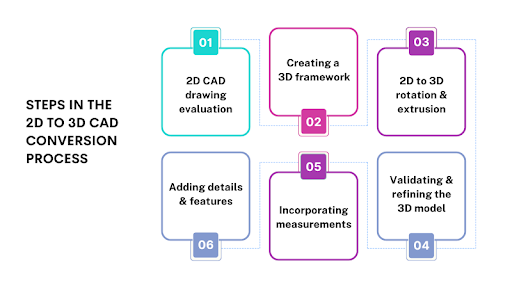
Although every autocad conversion services provider has its own workflow, the standard process usually includes the following steps:
1. Requirement Analysis & Document Review
You submit your 2D CAD files (DWG, DXF, PDF, or scans).
The team reviews:
- Drawing clarity
- Dimensions
- Layers
- Missing information
- Ambiguities
You may be asked follow-up questions to ensure accurate 3D reconstruction.
2. Setting Project Scope & Timelines
At this stage, the service provider defines:
- Deliverables (3D solid models, surface models, BIM-ready files, renderings, etc.)
- Software (AutoCAD 3D, SolidWorks, Revit, Fusion 360, etc.)
- Deadlines
- Budgets
Clear scope avoids rework later.
3. Converting 2D Drawings to 3D Models
This is the core step where engineers translate:
- Plans
- Sections
- Elevations
- Fabrication drawings
into detailed 3D models.
Every line, arc, radius, or dimension is reconstructed in 3D to ensure functional and visual accuracy.
4. Quality Checks & Design Validation
The best companies perform multi-level checks:
- Geometry integrity
- Scale accuracy
- Component alignment
- Layer mapping
- Clash detection (for architectural/structural projects)
- Conformance to industry standards
5. Revision Cycles & Final Delivery
Most teams offer:
- 1–3 revision rounds included
- Multiple file formats (DWG, STEP, STL, RVT, OBJ, etc.)
- Cloud-based delivery
Once approved, your final 3D model is ready for engineering, visualization, or manufacturing.
How Accurate Are Outsourced 3D Models Compared to In-House Models?
Accuracy depends on the clarity of your inputs and the experience of your vendor. However, most established 2d to 3d conversion drawings teams deliver:
- 99% dimensional accuracy
- Strict tolerance control
- Compliance with ISO and AEC standards
Studies from Autodesk Industry Reports show that 3D models reduce design errors by up to 70%, improving project coordination significantly.
What Are the Benefits of Outsourcing 2D AutoCAD to 3D Conversion?
Here’s what businesses in the UK and globally usually gain:
🔹 1. Improved Visualization for Clients
A 2D drawing may be clear to engineers—but not to a client or investor.
3D models communicate design intent instantly.
🔹 2. Reduced Revisions During Construction
3D models help detect conflicts early, drastically lowering on-site errors.
🔹 3. Better Collaboration With Fabricators & Contractors
3D files can be used for CNC machining, rendering, walkthroughs, and BIM workflows.
🔹 4. Increased Speed & Productivity
Outsourced partners often work with dedicated 3D specialists who deliver faster than internal generalists.
🔹 5. Access to New Tools & Technologies
Leading firms use:
- Autodesk 3D
- Revit BIM
- SolidWorks
- Inventor
- 3ds Max
You get advanced tools without paying for software licenses.
What Challenges Should You Expect During Outsourcing?
Even though the benefits are significant, there are a few challenges to be aware of.
1. Communication Gaps
If 2D drawings lack details or contain inconsistencies, delays may occur.
2. Misaligned Expectations
Not defining required file formats, levels of detail (LOD), or modeling standards can lead to rework.
3. Time Zone Differences
This can be a benefit or a hurdle, depending on how effectively communication is managed.
4. Quality Variation Among Vendors
Not all autocad conversion services deliver the same accuracy or speed.
How to Avoid These Issues?
- Provide clear input files
- Request a sample test project
- Confirm quality standards beforehand
- Choose vendors with UK/USA project experience
What Should You Look for in a Reliable 2D to 3D Conversion Company?
When choosing a partner, evaluate your vendor on the following criteria:
✔ Experience across multiple industries
Architectural, structural, product design, MEP, or millwork.
✔ Software expertise
AutoCAD 3D, Revit, SolidWorks, Fusion 360, Inventor, etc.
✔ Strong portfolio and case studies
✔ Fast turnaround time
✔ Data confidentiality & NDA compliance
✔ Quality control standards
✔ Transparent pricing
✔ Flexibility for small and large projects
The best vendors are those who act as an extension of your internal team—not just a low-cost alternative.
How Much Does Outsourcing 2D to 3D Conversion Cost?
Pricing varies based on:
- Drawing complexity
- Required level of detail
- Type of model (solid, surface, BIM-ready)
- Turnaround time
- Output software
Typical UK/USA outsourcing ranges:
- Simple models: £30–£75 per drawing
- Moderate complexity: £75–£200
- High-detail or BIM models: £200–£600+
For recurring or bulk projects, most companies offer discounted rates.
What Are the Latest Trends in 2D to 3D AutoCAD Conversion?
Like the rest of the design industry, conversion workflows are also evolving rapidly.
1. AI-assisted conversion tools
AI tools can now automate 30–40% of geometry recognition, improving speed and reducing manual work.
2. UK push toward BIM Level 2 & ISO 19650 standards
More firms want 3D conversion for BIM compliance.
3. Rise of AR/VR-ready models
Many companies now request conversion services for AR/VR visualization.
4. Growth of remote talent & global outsourcing
More UK firms rely on global specialists for high-quality and cost-effective 3D work.
Conclusion:
Whether you are an architect, contractor, product designer, engineer, or business owner, outsourcing your 2d drawing to 3d model conversion can significantly enhance your productivity, improve design outcomes, and reduce costs.
With clearer visualization, fewer errors, faster approvals, and better collaboration across teams, the benefits far outweigh the challenges especially when working with an experienced partner.
If you’re looking for a trusted outsourcing partner, many businesses in the UK rely on leading CAD design companies that specialize in AutoCAD, 3D modeling, and digital drafting solutions for global markets. These partners bring the technical expertise, speed, and scalability required to support modern design workflows.