The Secret to Sealing Uneven Mating Surfaces Permanently
In the fields of industrial manufacturing, automotive restoration, and heavy mechanical engineering, fluid containment is a fundamental measure of structural integrity. Pipelines, engine blocks, hydraulic reservoirs, and compressor housings are designed to transport or contain volatile fluids and gases under varying levels of pressure and temperature. The primary point of vulnerability in any of these systems is rarely the solid metal walls of the vessel itself; rather, it is the mechanical joint where two separate components interface.
In a theoretically perfect manufacturing scenario, mating surfaces would be completely flat, rigid, and smooth down to the microscopic level. In the real world, however, engineers continuously confront the challenge of uneven mating surfaces. Heavy components warp over years of thermal cycling, surfaces develop deep pitting from chemical corrosion, and machining tolerances can introduce subtle structural waves across a metal face. Attempting to seal these imperfect interfaces using standard, rigid methods is a recipe for premature joint failure. Achieving a permanent, leak-free seal on uneven surfaces requires a deep understanding of material compliance, surface topography, and controlled mechanical compression.
1. Understanding Microscopic Surface Topography and Flange Warpage
To effectively seal an imperfect joint, one must first visualize the boundary layer at a microscopic scale. Even a metal flange that appears perfectly smooth to the naked eye features an intricate landscape of peaks and valleys, known as surface roughness. When two mating surfaces are brought together, they only make physical contact at their highest points, leaving an interconnected network of microscopic voids through which high-pressure fluids and gases can easily escape.
This sealing challenge multiplies exponentially when macro-level unevenness, such as flange warpage or structural deflection, is introduced. This occurs when the tightening of heavy fastening bolts causes the metal between the fasteners to bow outward slightly. If a sealing material is too rigid, it will fail to deform sufficiently to fill these macro-gaps, creating localized low-pressure zones that quickly develop into active leak paths. A permanent seal demands a material capable of micro-deformation—meaning it can flow into the tiny surface scratches—while possessing the structural macro-compliance needed to bridge significant structural waves across the flange face.
2. Leveraging Material Yield and Compressibility Ratios
The secret to conquering uneven mating surfaces lies entirely in the physics of compressibility and elastic recovery. A sealing medium must possess a low initial yield stress, allowing it to deform under moderate bolt loads and completely fill both microscopic and macroscopic imperfections on the mating faces.
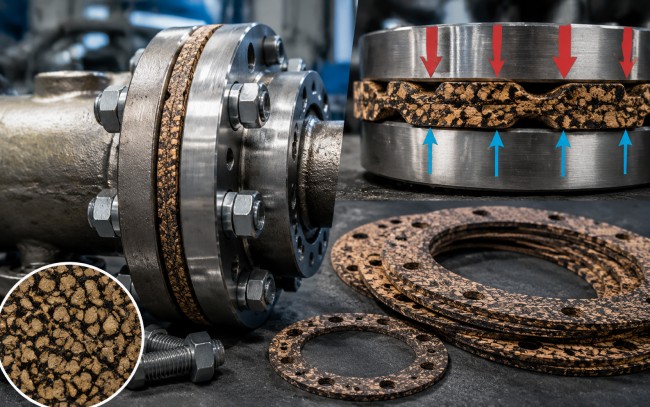
For low-to-medium pressure applications, such as automotive oil pans, valve covers, electrical enclosures, and vintage machinery casings, choosing a highly compliant composite material is an exceptionally effective strategy. Utilizing a high-yield cork gasket material remains an industry benchmark for navigating these highly irregular joints. Natural cork possesses a unique cellular structure filled with microscopic air pockets that compress cleanly under load without expanding outward laterally. When bound with synthetic elastomers like nitrile or neoprene, this material combination delivers exceptional conformability. It allows the seal to compress deeply in tight zones where bolt pressure is concentrated, while maintaining sufficient thickness and resilience in warped, wide-gap areas to block fluid migration entirely.
3. The Role of Elastic Recovery and Internal Resilience
Deforming a material into an uneven gap is only half of the engineering equation. Industrial machinery is a dynamic environment subject to continuous operational variables, such as vibration, shifting pressure loads, and intense thermal expansion loops. As internal temperatures rise, different metals expand at varying rates, causing the gap between the mating surfaces to continuously widen and narrow.
A permanent seal requires a material with a high rate of elastic recovery, or the physical capacity to spring back and maintain a continuous pushing force against the metal faces when joint pressure relaxes. If a material experiences excessive plastic deformation—meaning it crushes permanently and loses its internal spring force—it will fail the moment the joint cools or shifts. Specialized composite materials retain this vital memory, acting like a continuous internal spring that actively tracks the shifting contours of the uneven flange, ensuring that the critical sealing boundary remains completely unbroken over thousands of operational cycles.
4. Mastering Controlled Torque and Parallel Flange Compression
Even the most advanced, highly compliant material will fail prematurely if the mechanical installation process is executed haphazardly. The ultimate goal of joint assembly is to achieve parallel flange compression, ensuring that the sealing medium is loaded completely evenly across its entire surface area, regardless of the underlying structural irregularities.
When technicians tighten fastening bolts in a random, circular sequence, they accidentally drive the unevenness of the metal forward, trapping physical waves within the flange and shearing the sealing material. Eliminating this risk requires a disciplined, multi-stage cross-bolt pattern managed by precise torque calculations. By gradually loading the fasteners in incremental steps—such as thirty percent, sixty percent, and finally one hundred percent of target torque—the compliant material is given sufficient time to flow smoothly into the structural valleys of the joint, preventing dry spots and ensuring long-term containment stability.
Conclusion
Sealing uneven mating surfaces permanently is never a matter of luck or applying excessive amounts of synthetic chemical sealants; it is a calculated triumph of material selection, mechanical physics, and installation discipline. By accurately visualizing surface topography, leveraging the compressibility of composite cork and elastomer materials, prioritizing elastic recovery, and executing precise, incremental torque sequences, engineers can successfully eliminate joint vulnerability. Protecting these fluid interfaces ensures that industrial assets can operate continuously at peak efficiency, completely free from the threat of unexpected environmental leaks, structural friction, and costly unscheduled maintenance downtime.