The Hidden Technology Inside Modern Vehicles You Probably Never Notice
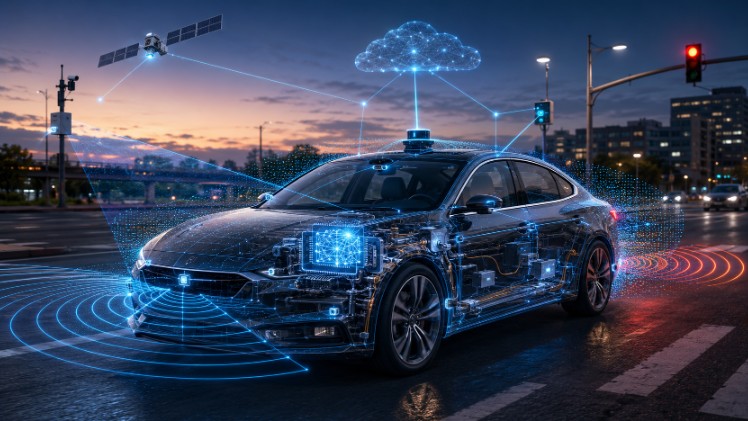
Modern cars may still look, on the surface, like familiar machines built around engines, wheels and steering wheels. But beneath that familiar exterior is a quiet shift: today’s vehicles are closer to rolling sensor networks than traditional mechanical systems. Much of what defines a modern driving experience now happens invisibly—through radar pulses, camera arrays, onboard processors and constant data exchange.
For most drivers, these systems require no interaction at all. They simply work in the background, interpreting the road, predicting movement and adjusting vehicle behaviour in real time.
A network of sensors replacing pure instinct
One of the most significant changes in modern automotive design is the shift from mechanical awareness to sensor-based perception.
Radar systems are now common in even mid-range vehicles. They continuously measure distance and speed relative to surrounding objects, enabling features like adaptive cruise control and automatic emergency braking. Unlike cameras, radar performs reliably in poor weather, making it a critical safety backbone.
LiDAR, increasingly used in higher-end and experimental autonomous systems, takes this further by mapping surroundings in three dimensions using light pulses. While not yet standard across all consumer vehicles, its influence is growing as manufacturers refine semi-autonomous driving capabilities.
Alongside these, ultrasonic sensors manage close-range awareness—useful for parking assistance and obstacle detection in tight urban environments.
Together, these systems form a layered perception model, replacing human-only judgement with machine-assisted awareness.
Onboard AI: the quiet decision-maker
If sensors are the eyes of modern vehicles, artificial intelligence is increasingly becoming the brain.
Onboard AI systems process enormous streams of data in milliseconds. Their role is not just to react, but to interpret patterns. For example, they can distinguish between a stationary object and a pedestrian about to step into the road, or predict lane changes from nearby vehicles based on subtle movement cues.
Machine learning models also refine driver assistance over time. The more a system is used, the more it adapts to driving style, road conditions and common routes. This creates a feedback loop where the vehicle becomes more personalised the longer it is driven.
Importantly, much of this computation now happens directly within the car itself, reducing reliance on constant cloud connectivity and improving response times.
Connectivity: the car as a digital participant
Modern vehicles no longer operate in isolation. Built-in connectivity systems allow them to communicate with external infrastructure, other vehicles, and cloud-based services.
This enables real-time traffic updates, predictive navigation and over-the-air software updates that can improve performance without a visit to a workshop. In some cases, manufacturers can even adjust vehicle behaviour or introduce new features long after purchase.
Vehicle-to-everything (V2X) communication is also emerging, allowing cars to eventually “talk” to traffic lights, road sensors and nearby vehicles. While still in early stages in most regions, it represents a significant step towards coordinated, data-driven transport systems.
Driver assistance is becoming the default, not the upgrade
Features once considered luxury additions—such as lane-keeping assistance, blind-spot monitoring and automatic braking—are now increasingly standard.
What’s notable is how seamlessly these systems operate. Drivers often don’t realise how frequently the car is making micro-adjustments: gently correcting steering, modulating braking pressure, or maintaining safe distance in traffic.
This subtle intervention is intentional. The goal is not to replace the driver, but to reduce cognitive load, especially in congested or monotonous driving conditions.
Personalisation beyond performance
While much of modern automotive technology focuses on safety and efficiency, there is also a growing emphasis on identity and personalisation.
Digital dashboards, ambient lighting systems and software profiles now allow drivers to shape the feel of a vehicle far beyond physical modifications. Even exterior design elements are becoming more customisable through digital ordering systems and modular manufacturing approaches.
In this evolving landscape, even traditional identifiers such as number plates have taken on a more design-conscious role. For drivers who see their vehicle as an extension of personality rather than just transport, details matter. Services such as Number 1 Plates exist within this broader shift towards automotive individuality, where visual presentation and identity increasingly overlap.
The road ahead: invisible complexity, visible simplicity
As vehicles continue to evolve, the paradox becomes clearer: cars are becoming more technologically complex, while simultaneously feeling simpler to use.
Most drivers will never interact directly with radar systems, LiDAR processing units or neural network models running inside their dashboards. Yet these systems increasingly define how safe, smooth and intuitive modern driving feels.
The next decade is likely to deepen this trend further. With improvements in edge computing, sensor fusion and connectivity standards, the car will continue transitioning from a mechanical product into a continuously updated digital platform.
What remains constant is the driver’s experience behind the wheel. Even as the technology grows more sophisticated, its purpose remains understated: to make the act of driving safer, more efficient, and increasingly effortless—without most people ever noticing the machinery making it possible.