Castel del Monte and the Vatican to Rialto Bridge: Exploring Italy North to South
Italy’s geography runs against the direction most visitors travel it. The country extends nearly 1,300 kilometres from the Alps to the toe of the boot, and the differences between the north, centre, and south are more significant than any single image of Italy captures. Moving through it with some attention to that range – from Puglia’s ancient trulli to Venice’s canal palaces – is the most honest way to understand what the country actually is.
Puglia: The Deep South
Puglia occupies the heel of the Italian boot and has a character shaped by its position – far from the northern cities that most visitors use as their entry point, exposed to centuries of Greek, Byzantine, Norman, and Spanish rule that left architectural layers visible in the stone of every town. The Valle d’Itria in the centre of the region is where the trulli are concentrated – whitewashed limestone houses with conical dry-stone roofs built using a technique specific to this area and found almost nowhere else in the world.
Alberobello is the town most associated with them and is a UNESCO World Heritage Site; the density of trulli in the two historic districts (Rione Monti and Aia Piccola) is the highest anywhere, though the commercialisation of the lower Rione Monti district means the less-visited Aia Piccola gives a more authentic sense of how these buildings actually function as homes and workshops.
For visitors planning to explore the region in depth, top Puglia tours that cover the Valle d’Itria, the Salento peninsula, and the Gargano promontory give access to three distinct landscapes within a single region – olive grove plateau, Adriatic coast, and the limestone karst of the Murge – that require several days to move between properly.
The Salento in the far south, with its Baroque towns of Lecce and Otranto and the clear waters of the Ionian and Adriatic coasts, is the part of Puglia that has seen the most tourism growth in the past decade and still feels considerably less crowded than comparable stretches of the Amalfi Coast or Cinque Terre. Lecce’s Baroque architecture – the local golden limestone worked into an exuberance of carved facades on churches, palaces, and civic buildings across the historic centre – earns its description as the Florence of the south without quite reducing to that comparison.
Castel del Monte
Castel del Monte in the Apulian uplands above Andria is one of the strangest buildings in medieval Europe. The octagonal castle built by Holy Roman Emperor Frederick II around 1240 has an octagonal courtyard and eight octagonal towers, all in perfect geometric proportion, and it sits alone on a hill with no town or defensive context around it – it was never garrisoned, never used as a defensive position, and may never have been intended for military use at all.
What Frederick intended it for remains debated: an astronomical observatory, a hunting lodge, a symbol of imperial power expressed in geometry. The interior, now empty, has rooms whose proportions and orientation suggest that light at specific times of year was a design consideration. Whatever the original purpose, the building is unlike anything else in Italy and the approach up the hillside road, with the castle appearing on the horizon long before you arrive, is part of what makes it affecting.
Florence to Venice
The train Rome to Venice takes around three and a half hours on the Frecciarossa high-speed service and passes through Florence – which is worth treating as a stop rather than a transit point. Florence’s Santa Croce basilica in the east of the historic centre holds the tombs of Michelangelo, Galileo, and Machiavelli, among others, and the Pazzi Chapel in the basilica’s first cloister is one of the finest small architectural spaces of the Renaissance, designed by Brunelleschi in the 1430s and remarkable for the precision of its proportions.
The Oltrarno neighbourhood south of the Arno – the streets around Piazza Santo Spirito and the Piazza dei Pitti – gives a more residential version of Florence than the north bank’s museum corridor, with food markets, craftspeople’s workshops, and a slower pace that makes the city feel like somewhere people actually live.
Venice is where the Italian journey reaches its most extreme expression of the relationship between a city and its geography. The historic centre covers around 7 square kilometres across 118 small islands connected by 400 bridges, with no cars and no roads – only canals and pedestrian paths.
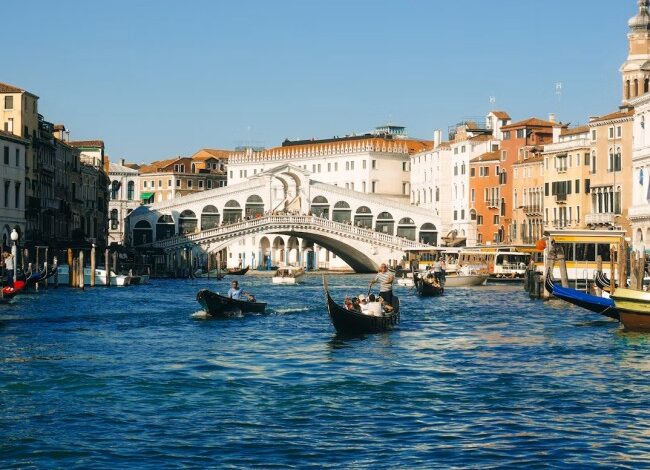
The Rialto Bridge, the oldest of four bridges crossing the Grand Canal, has stood in some form since the 12th century and the current stone structure dates from 1591; the market that has operated at its foot since the city’s earliest days still sells fish and vegetables from the same market buildings, divided between the Pescheria (fish) and Erberia (vegetables) pavilions on the canal bank. The experience of arriving at the Rialto by vaporetto and walking into the market at 7am, before the tourist tide arrives, gives a version of Venice that the midday crowds make nearly inaccessible.
Rome and the Vatican
Rome is a city that works against efficient sightseeing, which is the correct way to approach it. The density of monuments, churches, and archaeological sites in the historic centre is unmatched anywhere in the world, and the temptation to cover everything produces a form of sensory overload that leaves visitors remembering nothing specifically. Better to choose a period or a theme – Republican Rome, Baroque churches, the Counter-Reformation – and follow it through the city for a day or two, which turns what might be a passive experience of standing in famous places into an active process of reading a city.
The Vatican occupies 44 hectares within Rome and its own collections are a separate undertaking from the city around it. The Vatican Museums hold around 70,000 works, of which around 20,000 are on display at any given time, and the Sistine Chapel at the end of the museum route is the focal point that most visitors have arrived specifically to see.
The ceiling painted by Michelangelo between 1508 and 1512 and The Last Judgement on the altar wall completed between 1536 and 1541 are experienced together in a room that is usually crowded, often warm, and always noisier than the attendants prefer. The visit is still worth making, but the rest of the Vatican Museums – particularly the Gallery of Maps, the Raphael Rooms, and the Pinacoteca – are what most visitors move through too quickly in the rush toward the Sistine Chapel.
The Rialto and Beyond
Venice rewards visitors who move away from the main tourist circuit between the Rialto and San Marco. The sestieri (districts) of Cannaregio in the north, Dorsoduro in the south, and Castello in the east each have a neighbourhood character that the heavily visited centre loses to the crowds.
The Cannaregio canal – the main waterway running from the station end of the city toward the Rialto – is lined with local bars and restaurants that have the quality of places still primarily used by residents. The Frari church in San Polo holds two of Titian’s greatest works, including the Assumption of the Virgin above the high altar, in a Gothic brick interior that is one of the most affecting spaces in Venice.
The islands visible from Venice are accessible by vaporetto and each adds a dimension to the city. Murano, 15 minutes north, has been producing glass since the Venetian Republic relocated the glassblowers there in 1291 to reduce fire risk to the main city; the furnaces still operate and the Glass Museum traces the technique from the medieval period to the present.
Burano, another 30 minutes north, is the lacemaking island whose brightly painted houses are among the most photographed in Italy. Torcello, the island that predates Venice itself and was once more populous, now has barely 10 permanent residents, a Byzantine cathedral from the 7th century, and a quality of silence that the city across the water hasn’t had for centuries.
Conclusion
Italy from Puglia to Venice is not one country in any straightforward sense – the food, the architecture, the dialect, and the pace of life shift substantially every few hundred kilometres. That range is precisely what makes the full-length journey worthwhile. The landmarks along the way are the anchors; everything between them is where the country actually lives.