Beyond the Laps: Why Play is Amman’s Best Tool for Raising Confident Swimmers
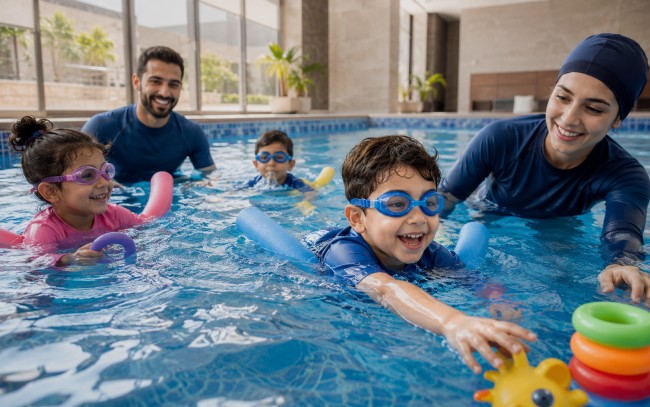
Teaching a child to swim is rarely about rigid drills and lap counts in the early stages—whether you are dipping a toe into a backyard pool or visiting one of Amman’s local swim academies. It is about trust, play, and removing the fear of water one giggle at a time. The fastest way to build that comfort is through structured, purposeful play. In fact, the right swimming games can do more for a beginner than weeks of strict instruction. When children are laughing, they stop bracing against the water and start moving with it, which is exactly the mindset a young swimmer in Amman needs before stroke technique ever enters the picture.
This approach matters because fear is the single greatest barrier in early swimming. A child who tenses up will hold their breath incorrectly, lift their head, and sink their hips. On the other hand, a child who is relaxed floats more easily and learns much faster. By turning lessons into games, we solve the fear problem organically, helping Amman’s youngest swimmers dive into the sport with confidence before they even realize they are training.
Why Play Beats Pressure in the Early Stages
Young learners have short attention spans and a strong instinct to avoid anything that feels like failure. Traditional repetition can amplify anxiety. Game-based learning flips that dynamic by hiding the skill inside the fun.
A well-designed game quietly trains one or two specific competencies at a time:
- Breath control through blowing bubbles and underwater challenges
- Floating and balance by encouraging relaxed body positions
- Submersion confidence with treasure-hunt style retrieval games
- Propulsion through chase and travel games across the shallow end
- Listening and safety habits by responding to start-and-stop commands
Because each game has a clear physical goal, progress is measurable even when it looks like pure recreation.
Five Games That Build Real Skills
Below is a quick reference for parents and instructors. Each game targets a foundational skill that later supports proper stroke development.
| Game | Skill Built | Best For |
| Blowing Bubbles Race | Breath control & exhaling underwater | Absolute beginners |
| Ring or Toy Dive | Submersion & eyes-open confidence | Nervous submergers |
| Red Light, Green Light | Listening, control, propulsion | Group classes |
| Superman Glide | Streamline body position & floating | Pre-stroke learners |
| Motorboat Circle | Kicking power & rhythm | Building leg strength |
Bubble Games for Breathing
Exhaling underwater is the foundation of every stroke. Turning it into a “who can make the biggest bubbles” contest removes the instinct to hold the breath and panic. Once a child breathes out comfortably under the surface, rhythmic breathing during freestyle becomes far easier.
Retrieval Games for Submersion
Dropping sinking toys or rings into shallow water and asking the child to collect them teaches them to open their eyes, reach, and stay calm below the surface. This single habit eliminates the flinch reflex that holds so many beginners back.
Travel Games for Propulsion
Games that ask children to move from one wall to another, whether chasing, racing, or pretending to be a motorboat, develop kicking power and the confidence to leave the safety of the edge. These are the building blocks of independent swimming.
How Coaching Quality Changes the Outcome
Games only work when they are sequenced correctly and supervised by people who understand both safety and skill progression. That is where an experienced program makes the difference.
The coaching team at Piranha swim team in Sweifieh, Amman structures play around clear developmental milestones, so each session feels like fun to the child while steadily advancing their water competence. To make this professional training accessible to more families, their programs are also available at Al Hussain Youth City (Sport Circle) and the Arab Model School in Tla’a Al Ali.
Across all of these venues, their instructors read body language, adjust difficulty in real time, and know when a child is ready to move from play to technique.
The progression typically looks like this:
- Comfort phase — splashing, bubbles, and shallow-water games.
- Confidence phase — submersion, floating, and gliding games.
- Coordination phase — kicking and arm-movement games.
- Technique phase — translating play habits into real strokes.
Rushing a child past the comfort phase almost always backfires. The games exist to make that foundation solid, no matter which location a family chooses to join.
Tips for Parents at Home
You do not need a full pool to start building confidence. Bath time and shallow water are perfect for early practice:
- Encourage face-in-water bubble blowing during bath time
- Praise effort, never force submersion
- Keep sessions short and end on a positive moment
- Make pouring and splashing a normal, happy part of water play
These small habits mean a child arrives at their first real lesson already relaxed around water.
In the End
Confident swimmers are almost always made through joy first and discipline second. When water feels like a playground instead of a test, children learn the skills that keep them safe for life, often without realizing they were ever being taught. The next time you are near a pool, try swapping one instruction for one game and watch how quickly the fear melts away.
Which game do you think your child would beg to play first?