Germany Proxies Explained: Infrastructure, Speed, and Real-World Applications
It is difficult to avoid Germany when working with European data. A lot of Europe’s internet traffic goes through Frankfurt alone, and that kind of infrastructure has a direct effect on how well proxies work.
This guide shows how Germany proxies work, why the technology that supports them is important, and how they are used by companies.
Understanding How Germany Proxies Work
A Germany proxy uses a German IP address to send your requests. When you visit a website, it sees you as a German user rather than someone from another nation. This is important because websites and search engines will deliver results based on the purpose of a request.
Prices fluctuate, some content is only available in Germany, and search results change. You won’t be able to see what local users are seeing if you don’t have a German IP. The mechanics are simple to learn.
The request receives a local IP address and appears to have been made there after passing through a German proxy server. The answer is returned in the same manner – true, unfiltered, and localized.
Germany’s Internet Infrastructure
The internet backbone of Germany is among the most powerful in the world and the center is Frankfurt.
DE-CIX Frankfurt is the largest Internet Exchange in Europe, with a network of almost 1,100 networks. It achieved a new record of 18.73 Tbit/s in December 2025, and the annual traffic is 48 exabytes.
For proxy performance, this matters. German IPs offer trustworthy connections and low latency because the infrastructure behind them is among the best in the world.
Speed and Performance of German Proxies
The average fixed broadband speed in Germany is approximately 93-102 Mbps, and the mobile connections are 58-75 Mbps on average, depending on the carriers. Not the fastest in Europe, countries such as Iceland and Spain are the leaders in fixed broadband.
What Germany does not have in sheer speed compensates for in the density of the infrastructure. The internet exchange capacity of Frankfurt implies that the latency and routing are stable and this is more important to the performance of the proxy than the top download speeds.
Proxy type still plays a role. Datacenter proxies are the fastest option, suited for high-volume tasks where detection risk is low. Residential proxies are slower, yet much more effective on the websites that are actively filtering traffic.
In the middle, there are the ISP proxies, which have a residential level of trust and a datacenter level of speed, which is the most viable option for most Germany-specific tasks.
Real-World Applications of Germany Proxies
Germany is among the largest digital markets in Europe, and proper local data can only be gathered with a German IP.
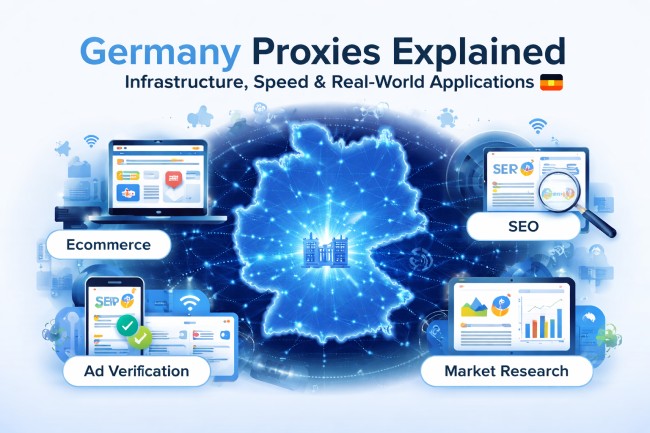
- E-commerce price optimization: German stores such as Otto, Zalando and MediaMarkt set prices depending on location. A German IP draws the very pricing local consumers are exposed to.
- Tracking SERP: Google.de gives different results than any other regional Google. German SEO teams should have a local IP to obtain correct data.
- Ad verification: Brands ensure that their ads are viewed as intended by the German audience, such as where, creatively, and targeting are accurate on the local platforms.
- Streaming and access to content: Germany has certain platforms and media services that can only be accessed within the country. That barrier is eliminated by a local IP.
- Market research: Local proxies are applied to help businesses entering the German market to gather reasonable consumer data, track the activity of competitors, and assess the availability of products.
- Protection of the brand: To prevent being detected, companies check German websites for the presence of counterfeits, unauthorized sellers, and trademark violations with the help of local IPs.
Types of German Proxies Available
Not all types of proxies are appropriate for all tasks. Here is their breakdown of Germany-specific use cases.
Residential Proxies
These are IPs allocated to German households by local ISPs. The most difficult to detect and block, the sites consider them a regular consumer traffic. Most effective in scraping, monitoring prices and any other activity where the detection risk is high.
Datacenter Proxies
Server-based German IPs. Quick and cheap, but easier to flag by sites. Best performs on high-volume tasks on platforms that do not use aggressive filters.
Mobile Proxies
Mobile proxy IPs such as Deutsche Telekom, Vodafone DE and O2. The highest trust level of any proxy type, shared among thousands of real devices on the same carrier network. Most appropriate for mobile-specific data collection and mobile platforms that are strict in detecting fraud.
ISP Proxies
Fixed residential IPs that are hosted on datacenter infrastructure. They are a combination of the datacenter proxy speed and residential IP legitimacy together. A practical middle ground for most Germany-specific tasks.
ProxyWing is a good place to start for all four types with German coverage. It offers competitive pricing, city-level targeting, and a sizable residential IP pool without the overhead of enterprise platforms.
Why Germany Remains a Strategic Proxy Location
The biggest e-commerce market in Europe is Germany. It is reflected in the competitive environment. Otto, Zalando, Temu, and Shein are all fighting for the remaining market share, with Amazon.de holding a dominant 63%. German IPs are necessary to keep an eye on prices and rankings on those platforms; anything else leaves you with an incomplete picture.
Mobile is also important. Mobile devices account for more than 66% of German e-commerce transactions. The majority of German consumers’ actual shopping habits are missed by desktop-only data collection.
All of this is supported by Frankfurt’s infrastructure, making Germany one of the few proxy locations that combines a significant digital market with top-notch connectivity.
Conclusion
Germany ticks all the boxes that count, including good infrastructure, low latency, and one of the largest digital markets in Europe behind it.
In the case of businesses that gather German data, the type of proxy you use will have a direct impact on the quality of the response you will receive. Residential and ISP proxies are the most reliable starting point for most tasks, they hold up on German platforms where datacenter IPs often don’t.
ProxyWing serves all the proxy types that have German coverage, city targeting, and competitive prices. If Germany is a market you’re serious about, it’s the most practical option to start with.