Understanding the real difference between GCSE and A level subjects
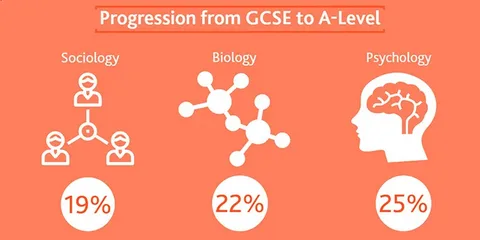
Students often move from GCSE to A level thinking it will be “the same, just harder.” It isn’t. A levels are designed to test depth, independence and exam technique at a higher level. GCSEs test broad understanding at the end of compulsory schooling. If you know the differences early, you can change how you study and avoid the usual drop in marks in the first term of sixth form.
Breadth versus depth
GCSE exams are built to cover a wide set of topics so that every student gets a rounded education. That is why GCSE science, maths, English, history and geography all feel fast, with lots of short topics.
A levels move in the opposite direction.
- Fewer topics
- Much more detail per topic
- More links between topics
- More marks for thinking, not recall
So if you study A levels using only GCSE style notes, your answers will sound thin.
Verified: A level specifications show fewer, deeper topics than GCSE.
Unverified: exact depth difference for every subject pair.
What the exam is really assessing
At GCSE the questions target “do you know this” and “can you use it in a simple way.” At A level the examiner wants to know:
- Can you select what is relevant
- Can you link two parts of the syllabus
- Can you explain and justify
- Can you set out a full method or argument
You will see more words like “evaluate,” “assess,” “to what extent,” “discuss,” “justify,” “analyse,” especially in humanities, business and social sciences. These are AO3 style tasks. GCSE has them too, but A level weighs them more.
Verified: A level assessment objectives place heavier weight on analysis/evaluation.
Unverified: percentage weight in your specific board and subject.
Change in question style
GCSE papers have lots of short questions, 1 to 4 marks, often with scaffolding. A level papers:
- Give longer questions worth 10, 12, 15, sometimes 25 marks
- Expect structured, paragraph style answers
- Use source material, graphs or case studies that you must interpret
- Give fewer clues in the question wording
If you try to write GCSE length answers in A level, you will leave marks on the table.
Change in timing and stamina
A level exams are usually longer. You may have 2 hour papers, or multiple long papers in the same week. That means your revision has to include:
- Full timed past papers
- Practice in writing long answers
- Energy management (sleep, food, breaks)
Students who only do notes and never attempt full papers often fail due to speed, not due to knowledge.
Expectation of independent study
GCSEs are taught step by step. Teachers guide more. A levels expect that you will:
- Read the specification yourself
- Pre read before lessons
- Make your own notes
- Fill gaps using past papers
- Ask for feedback and act on it
This is the stage where weak note making and weak error tracking start to show.
Linking topics across the course
In A level sciences, maths, economics, geography and psychology, questions will link ideas. For example:
- Maths: use algebraic skills inside calculus or statistics
- Biology: apply cell knowledge when explaining immunity
- Economics: join micro and macro in an evaluation question
You cannot do this if you revise in isolation. Your notes must show links.
Using board-aligned material makes this shift easier
A good way to manage the step up is to stay inside your board’s layout. A platform like SimpleStudy puts syllabus-matched notes, flashcards, quizzes, past papers and mock exams in one place for students in the UK, Ireland, Australia and other English-speaking markets. You can revise a GCSE topic that you are shaky on, then open the A level version of the same topic without hunting for it. If your school or parent has seats, the whole class can follow the same structure. That reduces confusion when everyone moves from Year 11 to sixth form.
What to change in your revision style
Move from this:
- Reading the chapter
- Highlighting
- Hoping it comes up
To this:
- Read the exact part of the specification
- Write your own 5–8 line note
- Do 3 to 5 A level past questions on that point
- Mark with the official scheme
- Log errors and redo in 48–72 hours
This is the method that matches A level marking.
Common mistakes in the GCSE → A level transition
- Using GCSE model answers as a template. They are too short.
- Ignoring examiner reports. Reports tell you what current A level markers want.
- Not reading the whole paper before starting. A levels often give choice.
- No practice with long answers. Then timing collapses in the real exam.
- Staying at recall level. A level wants explanation and judgement.
If you fix these in the first term, your grades will settle faster.
Why A levels feel “stricter”
A levels are used for university entry, college admission and training routes. Because of this, boards must make sure that a grade B in one year means the same as a grade B in another year. That is why the language in the mark scheme is tight, and why levels of response are used. You must show each step.
Verified: boards publish detailed mark schemes and levels of response for A levels.
Unverified: how each school trains students to use them.
Building back from GCSE when foundations are weak
Sometimes you did not fully understand a GCSE topic (fractions, electricity, grammar, Irish oral) and it now blocks A level learning. Do not guess. Go back.
- Relearn the GCSE version quickly
- Do 5 to 10 GCSE level questions
- Then repeat the A level version
- Then attempt an A level past question
Because SimpleStudy keeps topics lined up by syllabus and level, it is simpler to dip down for a refresher and then return to the harder content.
Final takeaway
GCSE checks what you were taught. A level checks how you think with what you were taught. That is the core difference. If you move to A levels and keep revising the way you did for GCSE, your marks will dip. If you switch to board-aligned notes, past papers, long answers and error logs, the step up becomes manageable.