Portugal’s Castles Through the Ages: Architecture, Legends, and Views
Portugal’s landscape is dotted with castles that look as though they’ve been lifted from old storybooks. Some cling to cliffs above the Atlantic, others stand proudly over river valleys, and many are wrapped in legends of queens, conquerors and long-forgotten battles. These fortresses are more than decorative ruins: they represent centuries of resilience, conflict, artistic reinvention and cultural exchange.
Travelling through Portugal’s castles reveals just how much the country has been shaped by the Moors, the Romans, medieval monarchs and maritime explorers. Their walls tell stories of defence and devotion, of strategic brilliance and romantic myth, all set against some of the most striking panoramas in Southern Europe.
Planning Your Portuguese Castle Route
Many travellers begin their cultural journey by exploring Portugal high-speed trains, which make it remarkably easy to hop between historic cities such as Lisbon, Porto, Coimbra and Faro.
The country’s efficient rail network allows visitors to explore far beyond the big cities, ensuring even rural castle towns are accessible without the need for a car.
Heading South to the Algarve
For those combining castle-hopping with coastal views, the Lisbon to Lagos train offers a relaxed and scenic avenue into the Algarve.
Arriving in Lagos places you within reach of dramatic clifftop fortresses and centuries-old maritime defences that once oversaw Portugal’s Age of Discovery.
The Moorish Influence: Castles of Conquest and Culture
Much of Portugal’s castle architecture bears the imprint of centuries of Moorish rule. Their strategic hilltop locations, horseshoe arches and clever defensive systems showcase a civilisation that valued astronomy, mathematics and detailed ornamentation.
Castle of the Moors, Sintra
Perched high above Sintra’s forests, this fortress winds along the ridgeline like a granite serpent. Built by the Moors in the 8th and 9th centuries, its vantage points offer sweeping views over the Atlantic and the palaces below. Wandering the ramparts on a misty morning is one of Portugal’s most atmospheric experiences.
Silves Castle
One of the best-preserved Moorish fortresses in Portugal, Silves Castle towers above an orange-grove valley in the Algarve. Its red sandstone walls and square towers hint at its former role as the capital of the Islamic kingdom of Al-Gharb. Today, it’s tranquil, warm and deeply evocative of its desert-influenced past.
Mediaeval Strongholds Built to Defend a Kingdom
When Portugal began forging its identity as a Christian kingdom, many fortresses were rebuilt or expanded to protect borders and newly reclaimed cities.
Guimarães Castle
Often called the birthplace of Portugal, Guimarães Castle is linked to the nation’s founding king, Afonso Henriques. Its Romanesque structure, combined with the surrounding granite boulders, creates an unforgettable silhouette. A visit here feels like stepping straight into the 12th century.
Óbidos Castle
Encircled by perfectly preserved walls, Óbidos is a jewel of mediaeval Portugal. Whitewashed houses with blue and yellow trim spill down its hillside, while the castle crowns the town like a guardian. The annual Mediaeval Fair transforms Óbidos into a living re-creation of its own history.
Bragança Castle
Located in the remote northeast, Bragança Castle stands in a wide plain surrounded by mountains. Its dramatic citadel, known as the Domus Municipalis, is one of the country’s most unique examples of Romanesque civic architecture.
Riverside Fortresses and Border Defences
Portugal’s rivers once formed crucial boundaries, and many castles were built to defend trade routes or control entry points.
Almourol Castle
Floating on a tiny islet in the Tagus River, Almourol Castle is one of the country’s most magical landmarks. Rebuilt by the Knights Templar in the 12th century, it can only be reached by boat, adding a sense of mystery and isolation.
Marvão
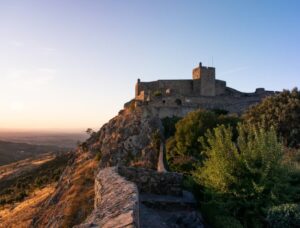
High in the Alentejo hills, the town of Marvão sits inside a fortress that seems to grow out of the rock itself. From its walls you can see Spain stretching out across the plains — a reminder of the centuries-long struggle to defend the border.
Romanticism and Reinvention: The 19th-Century Revival
Not all Portuguese castles are mediaeval. In the 1800s, artists and royals embraced Romanticism, reimagining castles as colourful, whimsical places blending influences from across Europe and North Africa.
Pena Palace, Sintra
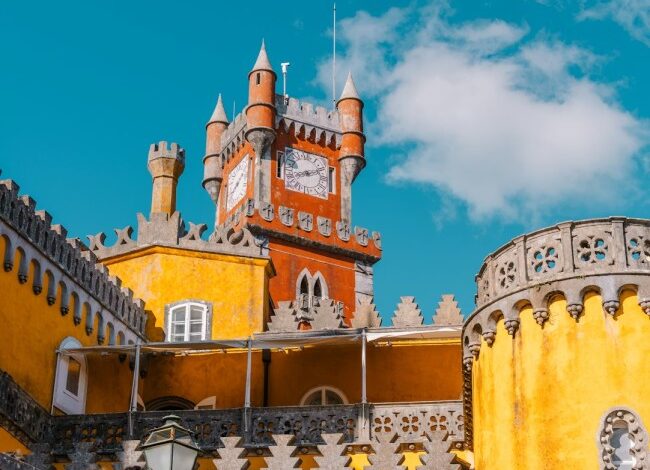
Possibly the most recognisable palace in Portugal, Pena mixes Gothic spires, Moorish arches, pastel colour blocks and tilework into a joyful architectural fantasy. Its surrounding parklands, filled with exotic trees and winding footpaths, add to the surreal beauty.
Bussaco Palace
Once a royal hunting retreat, this Neo-Manueline palace features elaborate carvings inspired by Portugal’s maritime past. Ornate stonework, lush gardens and tranquil forests make Bussaco an enchanting escape.
Legends, Queens and Ghost Stories
Portuguese castles are filled with folklore — tales handed down through generations.
- In Óbidos, legend says King Dinis gifted the town to his queen as a symbol of love.
- In Sintra, spirits are said to wander near the Castle of the Moors on misty nights.
- In Bragança, stories of star-crossed lovers echo through the keep.
These narratives bring character to the stones and help explain why locals treasure these sites not just as monuments, but as memory keepers.
Castles with Showstopping Views
Portugal’s geography makes almost every castle a viewpoint. Some offer Atlantic vistas, others overlook vineyards or sweeping plains.
Monsanto Castle
Built among enormous granite boulders in central Portugal, Monsanto Castle feels like a set from a fantasy film. The climb is steep, but the views stretch endlessly over rugged countryside.
Setúbal and Palmela Castles
Overlooking the Serra da Arrábida and the blue waters of the Sado Estuary, these two fortresses provide breathtaking views of coastal cliffs and green parklands.
Lagos’ Coastal Forts (The Algarve)
The Algarve coastline mixes castle ruins with maritime fortifications. Fort da Ponta da Bandeira, near Lagos, offers ocean views that frame the golden cliffs and turquoise waters Portugal is famous for.
Why Castle-Hopping in Portugal Is So Rewarding
Exploring Portugal’s castles gives travellers:
- A blend of Moorish, Romanesque, Gothic and Romantic architecture
- Stories that merge myth with history
- Unbelievable panoramas across mountains, rivers and oceans
- Walkable towns full of charm, cafés and local tradition
- An easy network of rail and road connections
Each castle is different — some imposing, others intimate — but all reveal the layers of people and cultures that shaped the nation.
Final Thoughts: Where the Past Shapes the Present
Portugal’s castles are living archives of a nation formed at the crossroads of empires, religions and continents. Their walls protect stories of ancient travellers, fierce battles, royal alliances and artistic transformation. Whether you’re admiring Sintra’s fairy-tale palaces or standing atop a lonely fortress in the Alentejo, these landmarks offer a journey deep into the soul of Portugal.
With its efficient transport links, varied landscapes and beautifully preserved towns, Portugal invites travellers to wander slowly — to climb the towers, to walk the walls, to imagine the lives once lived behind the stone.