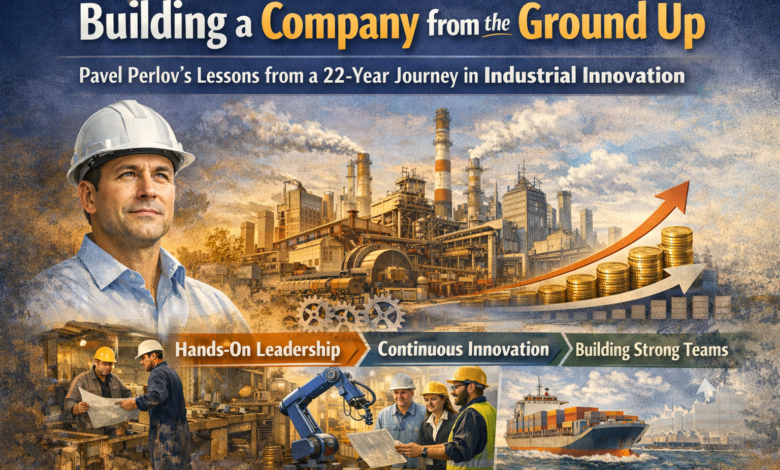
Building a Company from the Ground Up: Pavel Perlov’s Lessons from a 22-Year Journey in Industrial Innovation
Building an industrial company from nothing is rarely about a single breakthrough or moment of luck. It is the result of years spent refining processes, responding to operational setbacks, and learning how technology, people, and market forces interact over time. Pavel Perlov’s 22-year journey in industrial innovation reflects how sustainable growth comes from disciplined decision-making, long-term vision, and a willingness to adapt without losing focus. Examining this type of career offers valuable insight into what it truly takes to scale an industrial enterprise in a demanding and evolving market.
Starting with Constraints, Not Capital
Instead of starting with plenty, early-stage industrial endeavors frequently start with constraints. Founders are forced to prioritize efficiency due to limited funding, small teams, and unproven technology. These limitations influence the design of early infrastructure, the selection of suppliers, and the evolution of production workflows.
Successful industrial founders prioritize repeatability and dependability over developing unduly complicated systems too early. Investments are closely linked to operational demands rather than speculative growth, and processes are validated incrementally. This method lays a foundation that can support future growth without crumbling under its own weight.
Learning the Business from the Inside Out
Deep operational fluency is a distinguishing feature of long-term industrial leadership. An innate ability to spot inefficiencies, bottlenecks, and quality issues before they worsen is developed by leaders who work in manufacturing settings for years.
Every choice, from worker training to equipment purchase, is influenced by this practical knowledge. Experienced executives benefit from direct exposure to production realities rather than depending exclusively on outside advisors. This internal knowledge eventually turns into a competitive advantage that is hard for less experienced or inexperienced leadership teams to match.
Innovation as a Continuous Process
Innovation rarely disrupts industrial sectors all at once. It is gradual, progressive, and frequently imperceptible to outsiders. Over time, improvements in energy efficiency, automation, material handling, or throughput compound to yield significant gains.
Treating innovation as a continuous discipline rather than a one-time endeavor is essential for long-term industrial progress. Teams are encouraged to improve procedures rather than completely revamp them, systems are routinely assessed, and data is used to inform changes. This kind of thinking enables businesses to change gradually without causing operational instability.
Building Teams That Scale with the Business
Any industrial operation depends on people, but expanding a workforce has issues beyond hiring. Communication systems, accountability frameworks, and training initiatives must change in tandem with an organization’s headcount.
Establishing positions, performance criteria, and decision-making authority are early investments made by effective leaders. As layers are added to the structure, this clarity helps to avoid confusion. This focus on structure has allowed businesses to expand over the years without sacrificing operational discipline or cultural cohesiveness.
Navigating Market Shifts Without Losing Direction
Changes in consumer demand, supply chain interruptions, and regulatory changes all influence industrial markets. Businesses that endure for decades do so by making deliberate adjustments as opposed to hasty ones.
Making the distinction between short-term volatility and structural change is essential to long-term leadership. A multi-year perspective is used to assess investment choices, ensuring that modifications align with key competencies rather than following every fad. This equilibrium enables businesses to maintain their resilience without compromising their core competencies.
Managing Risk Through Process Design
In industrial businesses, risk frequently arises from missed subtleties rather than catastrophic failures. If not handled methodically, equipment failure, safety issues, and quality flaws can reduce revenue.
Rather than treating risk management as a distinct activity, seasoned business executives integrate it into process design. Everyday operations incorporate quality checks, safety procedures, and maintenance schedules. As scale grows, this eventually reduces unpredictability and yields more predictable performance.
Financial Discipline as a Growth Enabler
Financial discipline is just as important to sustained industrial expansion as ambition. Leaders who comprehend cash flow dynamics, depreciation cycles, and return-on-investment levels are rewarded in capital-intensive workplaces.
Disciplined businesses pace growth to preserve liquidity and operational flexibility rather than expanding rapidly when conditions are good. They are able to weather downturns, make strategic investments, and refrain from overleveraging during periods of expansion because of their financial prudence.
Leadership Evolution Over Time
Two decades later, a company’s leadership is very different from what it was in its early years. Founders must change from being practical issue solvers to strategic stewards as firms grow.
Delegating authority, having faith in specialized teams, and emphasizing long-term positioning over day-to-day execution are all necessary for this progress. Successful leaders are able to maintain the original vision and standards that propelled early success while allowing their organizations to operate autonomously.
Final Thoughts
A 22-year journey in industrial innovation illustrates that enduring success is built through consistency, adaptability, and operational depth rather than rapid shortcuts. The path followed by Pavel Perlov demonstrates how long-term thinking, disciplined execution, and incremental improvement can transform modest beginnings into a resilient enterprise. For industrial leaders and entrepreneurs alike, this type of experience underscores that sustainable growth is not about moving fast at all costs, but about building systems and teams that perform well over time.