Choosing the Perfect Coffee Table for Your Living Room
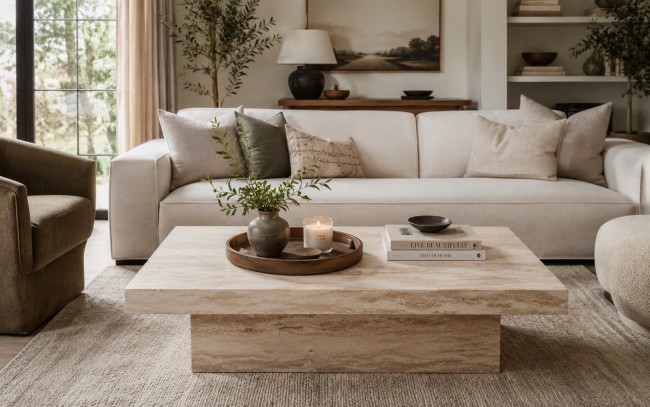
The coffee table is the gravitational centre of any living room. Everything orbits it — the sofa, the accent chairs, the rug, the conversation. Yet it is one of the most frequently underestimated furniture purchases. Shoppers often focus on the sofa first and treat the coffee table as an afterthought, which is how living rooms end up looking slightly off even when every individual piece is beautiful. Getting the coffee table right can pull an entire space together in a way that very little else can.
The First Decision: Material
Material is the single biggest stylistic choice you will make. Coffee tables come in several distinct material families, each with a different visual weight, maintenance requirement, and design message.
| Material | Visual Weight | Maintenance | Best Style Match |
| Solid wood | Medium–heavy | Low | Japandi, rustic, organic modern |
| Marble / stone | Heavy | Medium | Luxury contemporary, classic, maximalist |
| Travertine finish | Medium | Low–medium | Earthy, Mediterranean, boho |
| Concrete | Heavy | Low | Industrial, brutalist, minimal |
| Wood with marble | Medium | Medium | Transitional, modern eclectic |
| Nesting sets (wood) | Light (stackable) | Low | Small spaces, multifunctional rooms |
Travertine and travertine-finish concrete tables have dominated the design conversation for several years — their warm, fossil-pattern surfaces work equally well in sleek modern apartments and in warmer, more layered interiors.
Size and Proportion Rules
Getting the size wrong is the most common coffee table mistake. Too small, and the table looks lost; too large, and it blocks movement.
- Length: The coffee table should be approximately two-thirds the length of your sofa. A 210 cm sofa pairs well with a 140 cm table.
- Height: Should be roughly level with the sofa seat cushion — typically 40 to 45 cm.
- Clearance: Leave at least 40 to 45 cm between the table edge and the sofa front.
- Rug alignment: The coffee table should sit fully on the rug, with at least the front legs of the sofa also on it.
Shape: Round, Rectangular, Oval, or Irregular?
Rectangular tables are the most practical — they offer the most usable surface area and suit rectangular room layouts naturally. Round and oval tables soften the angles in a room and are safer in homes with children. Irregular and sculptural shapes function as conversation pieces in themselves — these work best when the rest of the furniture is restrained. Nesting sets solve the space problem elegantly, giving you a large primary surface plus a smaller secondary table you can pull out when entertaining.
Pairing the Coffee Table With the Right Sofa
The coffee table and sofa are essentially a partnership — they should feel like they belong to the same design conversation. A chunky concrete table sits comfortably in front of a deep, casual sofa; a delicate nesting set in natural oak looks elegant beside a curved boucle sofa in off-white or cream.
Avoid pairing very similar materials — a solid wood table directly in front of a wooden-legged sofa can feel monotonous. Instead, introduce contrast: a marble-top table against fabric upholstery, or a concrete surface against a velvet sofa.
Storage or No Storage?
If your living room doubles as a media room or a space that tends to accumulate things, a coffee table with storage is worth the investment. Many concrete and wood designs incorporate drawers or lower shelving that can hold remote controls, books, and small throws without creating visual clutter on the top surface. If the room is deliberately minimal, a coffee table without storage keeps the silhouette sculptural and uninterrupted.
Styling the Surface
An empty coffee table top is a missed opportunity. A few principles:
- Use trays to group smaller items — a candle, a small vase, a decorative object — so they read as one cohesive cluster.
- Vary heights. Stack two or three books, then place a low bowl beside them.
- Leave breathing room. A third to half of the surface should remain clear.
- One living element. A small plant or fresh stem brings organic energy to an otherwise static arrangement.
Final Thoughts
The best coffee table is the one that serves your actual life — not just the styled photoshoot version of it. Think about how you use your living room daily: do you eat on the sofa? Work from it? Entertain frequently? Let those habits drive the material, size, and storage decisions. A beautiful table that you are afraid to use is just expensive furniture. What does your current living room need most — sculptural interest, practical storage, or simply better proportion?