The Looksmaxing Scale Explained: What the PSL Tiers Mean, and Why to Take Them With a Grain of Salt
What is the looksmaxing scale?
The scale most looksmaxxers use is the PSL scale. The letters come from three now-defunct forums — PUAHate, SlutHate, and Lookism — where the system began. It scores facial attractiveness on roughly a 1-to-8 range (sometimes stretched to 10), with about 5 treated as the median, judging cues like facial harmony, symmetry, dimorphism, angularity, and skin quality. AI apps have automated it, reading those cues from a photo and returning a number and a tier.
The origins matter. These were communities built around ranking people, parts of them incel-adjacent, and the harshest labels at the bottom of the scale are openly dehumanizing. That history is baked into the tiers, which is the first reason to hold the whole thing loosely.
Why the scale went viral
None of this would matter much if it had stayed on a forum. What changed is TikTok, where ‘rate my PSL’ clips and the GigaChad meme turned a niche ranking system into mainstream entertainment, especially for young men. The appeal is simple: a free app offers a clear answer to an anxious question — how do I rank? — and a plan to climb. That blend of instant judgement and self-improvement is exactly what makes it stick, and what makes it easy to take far too seriously.
The tiers, from LTN to GigaChad
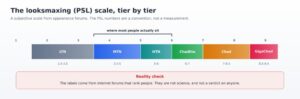
Within the scale, scores are grouped into named tiers. Here is how the looksmaxxing community describes them — with the caveat that the ranges are made up and shift from one rater to the next.
| Tier | PSL range | Said to be | Honest note |
|---|---|---|---|
| Low-Tier Normie (LTN) | ~1.5-3.5 | Below average; the bottom quarter | Often a photo or grooming problem, not a face one |
| Mid-Tier Normie (MTN) | ~3.5-5 | Average; the middle ~50% | Where most people sit — and perfectly normal |
| High-Tier Normie (HTN) | ~5-6 | Above average | Lighting and grooming move this band a lot |
| Chadlite | ~6-7 | Notably attractive | Still ordinary people, not a different species |
| Chad | ~7-8.5 | Model-tier bone structure | Rare, and heavily photo-dependent |
| GigaChad | ~8.5+ | Roughly the top 0.1% | Basically an internet meme |
Table 1. Tiers as described in looksmaxxing communities — a convention, not a scientific standard.
How AI apps put you on the scale
Automating the scale is simple: upload a selfie, the app measures a few facial cues, and it returns a number plus a tier. A free looksmaxing scale tool will do it in seconds and add a glow-up plan. Useful to know: that number is generated from one front-facing image, so it swings with lighting, angle, and expression as much as with your actual face.

Why the scale doesn’t hold up
Pull on the thread and the precision unravels. The score is subjective: feed the same face to different apps and you get different tiers, because each learned from different, biased human ratings. There is no fixed, scientific standard for beauty, so the decimals are theatre. And the scale only looks at a still face — it cannot see the things that actually move attraction in real life.
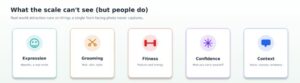
| What the scale scores | What real attraction also includes |
|---|---|
| Symmetry and facial proportions | A warm expression and a real smile |
| Jawline and bone structure | Grooming, style, and how you carry yourself |
| Skin quality in one photo | Fitness, posture, and energy |
| A single front-facing angle | Voice, humour, kindness, and context |
Table 2. The scale measures a sliver of what makes someone attractive.
The real risks
The bigger problem is what the scale does to people. Tying your self-worth to a tier is a fast route to feeling worse, and for teenagers especially it can feed body-image anxiety or dysmorphia. The communities behind it can pull users toward fatalism — the idea that a low score is a life sentence — and toward a harmful ‘hardmaxing’ fringe. The worst of it, ‘bonesmashing’ (hitting your face to alter the bone), is pseudoscience with a genuine risk of fractures and nerve damage. No tier is worth that. Clinicians and online-safety groups have repeatedly flagged appearance-rating trends as a driver of anxiety among teenagers.
A healthier way to think about it
If you enjoy looksmaxxing, keep the parts you control and bin the rest. Skincare, sleep, fitness, grooming, a haircut that suits you, clothes that fit, and plain confidence genuinely change how put-together you look — and they are open to everyone, regardless of tier.
Treat the number as a toy, take a better-lit photo if you want a confidence boost, and never use the scale to judge other people.
It helps to know what sits behind the score. Overchat’s looksmax tool is one of 150+ purpose-built tools inside Overchat AI, an all-in-one app spanning image, video, audio and text generation that runs on the latest models from GPT, Claude, Gemini, Grok, Kimi and Qwen. It works on web, iOS and Android and is used by more than 350,000 people. For anyone who would otherwise pay for separate ChatGPT, Claude and Gemini subscriptions, having those models in one place is the practical draw, though for a quick score you only need this one tool.
| Worth your energy | Not worth it |
| Skincare, sleep, fitness, grooming, style | Re-scoring your face on a loop |
| Confidence and how you treat people | Comparing yourself to GigaChad memes |
| A flattering, well-lit photo | Anything painful, starving, or surgical without a doctor |
Table 3. Where the real returns are.
FAQ
What is the looksmaxing scale?
It is the PSL scale, a 1-to-8-ish system looksmaxxers use to rate facial attractiveness and sort people into tiers from Low-Tier Normie to GigaChad. It is a subjective community convention, not a scientific measure.
What does PSL stand for?
PSL comes from three now-defunct forums: PUAHate, SlutHate, and Lookism, where the rating system began. The communities focused on ranking appearance, and that origin colours the whole scale.
What is a ‘normie’ or ‘Chad’ on the scale?
Normie tiers (LTN, MTN, HTN) cover most people, around a PSL of 1.5 to 6. Chad and GigaChad sit at the top, roughly 7 and above, and are described as rare, model-tier looks.
Is the looksmaxing scale accurate?
Not objectively. Apps are consistent but reflect biased data, and different tools rate the same face differently. There is no fixed standard for beauty, so treat any tier as entertainment.
Where did the looksmaxing scale come from?
From appearance-focused internet forums in the 2010s, parts of them incel-adjacent, before going mainstream on TikTok. The lowest tiers use openly dehumanizing labels, which is reason enough to be wary.
Is looksmaxing safe?
Softmaxing — skincare, grooming, fitness, sleep, and style — is safe and helpful. The harmful fringe, like bonesmashing or extreme dieting, is not. Stick to the basics and avoid anything painful or drastic.