Why the 1966 England Football Shirt Remains a National Treasure
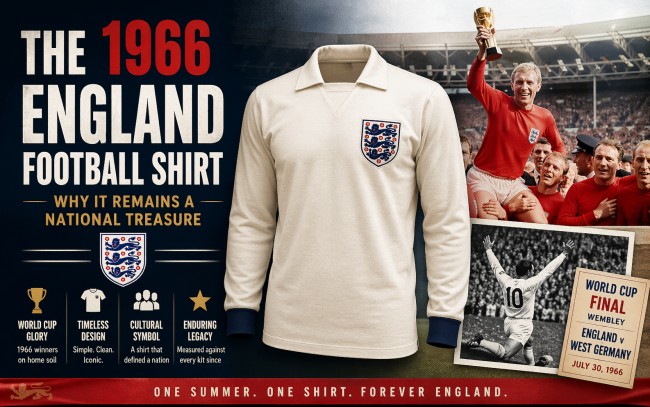
England has only one time gone on to win a World Cup and the jersey they wore at that summer is, even now, sixty years later, still one of the most iconic pieces of sportswear ever made. The 1966 England kit is not only remembered by football supporters – it has become a part of the country’s cultural landscape, being exhibited in museums, featured in documentaries, included in fashion collections, and shown in the homes of people all over the country.
Most people don’t really expect the shirt to be a simple one, and indeed it is. No sponsor, no flashy branding, no geometric patterns or tonal gimmicks. Just a collared crewneck with the three lions on the chest. And still it’s gone on to survive thousands of much more flamboyant designs that have come after it.
So here are the reasons that this particular shirt still occupies a spot as a national treasure, and why every new England kit is still measured against it whether designers like it or not.
The Summer That Changed English Football Forever
England has never hosted the World Cup other than 1966, and that single time England happened to be the champions too. Simply these two facts make the kit to have a certain kind of significance that no other England kit has ever succeeded in representing.
Alf Ramsey’s players were not believed by the majority to be the champions before the tournament began. Uruguay were held to a draw in the first game of the World Cup by England, then Mexico and France were just scraped to get out of the group for the second and third matches. The quarters onwards were marked by increasingly tougher matches, which led to the beautiful wins for England, quarter-final for a tough one with Argentina, a semi-final for the 2-1 win with Portugal, and both goals of Charlton are remembered vividly by people.
The match final was at Wembley, 30 July 1966 for England vs West Germany. After 90 minutes, the score was tied at 2-2, but in the extra time, Geoff Hurst scored his legendary second goal-the ball bounced down from the crossbar and whether or not it crossed the line depends on who you ask. In the last few moments, as the fans were rushing the pitch, Hurst scored his third goal leading to commentator Kenneth Wolstenholme’s now famous line “they think it’s all over”.
A Design That Did Almost Nothing and Got Everything Right
Umbro were responsible for making the 1966 England shirts. Their production was so minimal that it would have been almost shocking against the standards of today. The home kit was merely a white shirt with a collar, navy blue trim on the collar and cuffs, and the emblem of the three lions embroidered right on the chest. Not a single manufacturer logo on the front, no sponsor, no patterns, just plain fabric, the emblem, and clean lines.
The red away version was just the same in reverse -a red shirt with white trimming, the same badge in the same place, and nothing else diverting the eye. That level of visual simplicity is a large part of why both the shirts look so good after all these years. There is nothing on the shirts to date the design to a particular decade besides the cut and the fabric weight.
What most people remember about the shirts is the collar. It was a real folded collar instead of a V-neck or a modern crewneck, which gave the shirt a somewhat formal look that was in line with the times. Players only had their numbers on the back -no names, no squad numbers, no personalization. The kit was literally the bare minimum of what a football shirt had to have.
Why It Became a Cultural Symbol
The 1966 football kit is not only a remembrance in football world, but it is a cultural souvenir of 1960s Britain. It is a counterpart to the time that gave the world The Beatles, Mary Quant, and swinging London. England winning the World Cup was a part of a grander narrative of the nation feeling hopeful, fashionable and as if it was a part of something great.
That background is important. England winning the World Cup in the fifties or seventies would have changed the impact of the shirt culturally. However, 1966 came at a cultural turning point, turning the summer images -the fans at Wembley, Bobby Moore being lifted on his teammates’ shoulders, the Queen presenting the trophy -into deeply-rooted national myths.
The shirt regularly makes a surprise appearance. Oasis have incorporated it in their tours. Fashion houses have acquired the right to print it for their collaborative lines. Museums such as the National Football Museum in Manchester have the 1966 originals shirts on permanent display, as one of the most popular parts of the national history.
Why the Original Shirts Are Basically Uncollectable
Match-worn, original England shirts from 1966 belong to a completely different level than regular vintage jerseys. Once they are put on sale, they fetch prices that resemble sports memorabilia rather than garments. The 1966 World Cup final shirt of Bobby Moore himself has been estimated at well over 100,000 pounds and the jerseys of the other players in that team also often change hands for tens of thousands.
Even non-match-worn authentic pieces – replicas manufactured for the retail market in 1966 and thus casually worn by fans -are quite scarce and costly. The cotton did not endure decades of washing, most were worn to threads, and the rare ones that were found unworn in the backs of wardrobes have been already bought by serious collectors.
That scarcity created a huge market for high-quality reissues. Umbro, adidas, and specialist retro brands have all produced licensed versions of the 1966 shirt over the years, ranging from faithful recreations of the original cotton feel to modern polyester interpretations. If you want to browse current and retro football shirt replicas for England fans, the 1966-styled versions are usually among the most popular stock items, regardless of whether the country is actively playing in a tournament.
A Shirt That Raised the Bar for Every Kit That Followed
Each time that a new England kit has been revealed since 1966 the same silent comparison has always crept in. Does it have the neatness? The simplicity? The grace? Some even modern releases have been very well received – the Euro 96 Umbro indigo, the 2018 Nike home shirt, and a few others only. But none have quite managed to change the national image of the 1966 version.
It’s not really a design issue. It’s a history issue. No matter how nice a contemporary England shirt is, it hasn’t been on the back of a player lifting the World Cup at Wembley. Until England wins another major tournament the 1966 shirt will remain the best and all the following ones will keep being compared unfairly.
Why the Legacy Keeps Growing
The more time England spends without a follow-up World Cup win, the greater the significance of the 1966 shirt becomes. Every near miss since then – Italia ’90, Euro 96 2018 2020 – has added to the feeling of longing that the shirt represents. It has become a symbol of not only success but also what could have been.
Being a possession of some form of the 1966 kit is for many English football fans almost a coming-of-age moment. It doesn’t matter if it’s a recent retro reissue, a tribute-design modern shirt, or the original one carefully kept in a protective sleeve, that red or white jersey with the three lions is still the standard. Furthermore, it seems quite unlikely that anything will ever displace it as number one.