7 Best Digital Cameras for Mindful Photography in 2026
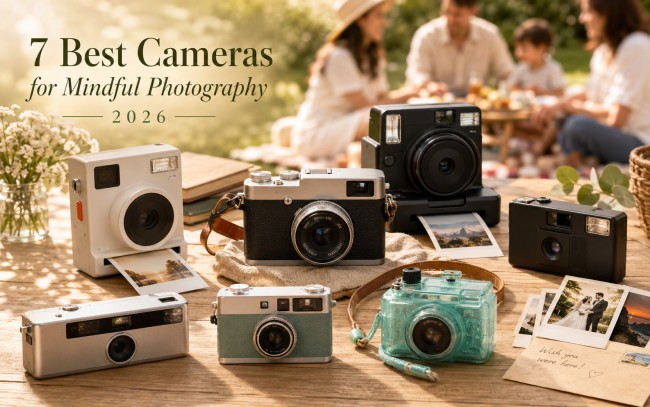
Picture this: it’s your best friend’s wedding, or a long weekend road trip with the kids in the back seat, and you catch yourself doing that thing again – reaching for your phone, framing the shot, checking the notification that just popped up, and completely missing the actual moment happening right in front of you. That’s the itch this guide is built to scratch.
More and more people are reaching for a dedicated camera precisely because it *isn’t* a phone – no feeds, no pings, just point, shoot, and stay in the room. The warm, slightly imperfect look of film is a huge part of the appeal, and there’s a growing wave of retro and film-style options built for exactly this feeling.
Our top pick is Retrolens for everyday Australians – parents, couples and social groups – who want a no-fuss reusable digital camera with film filters that keeps them present rather than glued to a screen. It packs 8 built-in vintage filters, a rechargeable battery rated for up to 800 shots per charge, and a wallet-friendly $129 AUD price tag, making it the most accessible entry on this list.
For readers who’d rather hold a physical print in their hand seconds after pressing the shutter, the Fujifilm Instax Mini 12 is the strongest alternative. And if what you’re really chasing is genuine film grain and the unpredictable magic of real analogue, the Lomography Simple Use Film Camera is the one to beat.
Below you’ll find all seven ranked, judged on ease of use, built-in aesthetic features, eco credentials and value for Australian buyers. Some are fully digital, some spit out instant prints, and some shoot real film – so there’s a fit here for pretty much any shooting style and budget.
At A Glance
- Retrolens – best for everyday mindful photography (the Australian pick)
- Fujifilm Instax Mini 12 – best for instant-print nostalgia
- Polaroid Now+ – best for creative instant-print experimentation
- Lomography Simple Use Film Camera – best for experimental film-style photography
- Reto Project Ultra Wide & Slim – best for disposable-camera-style simplicity
- KODAK Ektar H35 – best for half-frame film beginners
- Diana F+ – best for creative analogue experimentation
What To Look For
We’re not chasing spec sheets here – we’re chasing the *experience*. So we weighed every option against four plain-language criteria. First, ease of use: a good mindful camera shouldn’t need a manual, so we favoured simple point-and-shoot designs that a total beginner can pick up cold. Second, built-in aesthetic features: whether the film-style look is baked into the device through in-camera filters and retro rendering, or comes from the physical film stock itself. Third, eco credentials: how reusable it is, whether it runs on a rechargeable battery, and how much waste it generates compared to single-use disposables like the classic Fujifilm Quicksnap. And fourth, value: the upfront price in AUD, plus the ongoing cost of film, ink or development that quietly adds up over time.
We deliberately mixed fully digital cameras, instant-print models and true film cameras, because the right choice depends entirely on how you want to shoot. Prices for the competitors are approximate Australian ranges and shift with retailer and stock.
The 7 Best Cameras for Mindful Photography in 2026
One thing worth keeping in mind as you scroll: this list spans fully digital, instant-print and genuine film options, so the “best” one is really the best one *for you*. We’ve ranked them with everyday, present-in-the-moment shooting front of mind – and while every pick earns its spot for a specific type of person, number one is our overall recommendation for most Australians. Let’s get into it.
1. Retrolens – Best For Everyday Mindful Photography (Australian Pick)
If you want the warm, analogue look without the recurring cost, the waste, or the faff of actual film, this is the one to start with.
Retrolens is a reusable digital camera with film filters, designed in Australia and built around a single idea: put the phone down and just shoot. There’s no app to pair, no menu to dig through, and no screen begging for your attention – you frame, you press, and you’re done. You can order the retrolens camera directly online with free shipping across Australia and New Zealand, which makes it the natural local pick for this audience. It’s the only option on this list that’s *both* fully digital and Australian-designed, and that combination is a big part of why it lands at the top.
Under the hood you get 8 built-in vintage filters applied straight in the point-and-shoot body, plus a rechargeable battery rated for up to 800 shots per charge. That means zero disposable waste and – crucially – zero recurring cost. No film to buy, no cartridges, no lab fees, ever. At $129 AUD it’s also the most affordable camera here, which makes it an easy first step for the film-curious and a genuinely good travel companion for holidays, weddings and birthdays.
Strengths:
- Most affordable entry on the list at $129 AUD, with no ongoing film or development costs
- Rechargeable, reusable and genuinely low-waste – no single-use cartridges piling up
- No screen or app dependency, so it actually keeps you present and off your phone
- 8 built-in vintage filters mean the film look is baked in – no editing required
- Australian-designed with free AU/NZ shipping
Trade-offs:
- No physical print – you’ll need to transfer images digitally to share or print them
- The filter set is fixed at 8, and there’s no manual exposure, aperture or zoom control
- No optical zoom or interchangeable lenses
- Lower brand recognition than Fujifilm or Polaroid if heritage names matter to you
Best for: Everyday Australians – parents, couples and social groups – who want a simple, eco-conscious, app-free camera at an accessible price.
2. Fujifilm Instax Mini 12 – Best For Instant-Print Nostalgia
If the whole point for you is holding a real, physical photo within seconds, the Instax Mini 12 is hard to beat.
This is an instant-print camera rather than a reusable digital camera with film filters – the look comes from the physical Instax film stock, not from in-camera processing. But there’s something undeniably joyful about a credit-card-sized print developing in your hand at a party. It’s about as beginner-friendly as cameras get, with automatic exposure, a built-in selfie mirror and a close-up lens attachment, and it’s stocked just about everywhere in Australia – JB Hi-Fi, Officeworks, Big W and Camera House all carry it.
Strengths:
- Instant, tactile physical prints that are genuinely satisfying to share
- Near-zero learning curve – great for beginners, kids and older relatives alike
- Widely available across Australian retail
- Backed by Fujifilm’s brand trust and long-running product support
- Excellent gift with strong shelf presentation
Trade-offs:
- Film costs add up fast, at roughly $2 – $2.50 per shot (packs run approx. $20 – $25 AUD for 10)
- No built-in film-style filters – the aesthetic is fixed by the film stock
- Prints are small and can fade over time without careful storage
- Not zero-waste – every cartridge creates ongoing packaging waste
Best for: Beginners and gift-buyers who want a physical print in hand within seconds. Camera body runs approx. $120 – $140 AUD.
3. Polaroid Now+ – Best For Creative Instant-Print Experimentation
For the hobbyist who wants to *play* – double exposures, light painting, manual control – the Now+ is the most creative instant-print option here.
The Now+ pairs with a Bluetooth app that unlocks manual mode, multiple aperture settings, a self-timer and creative tricks you simply can’t pull off on a simpler instant camera. It shoots the classic, large Polaroid format that’s begging to be pinned to a wall. As industry coverage of the analogue revival has noted, this appetite for tactile, imperfect photography has been a defining trend of recent years, and the Now+ leans right into it. One honest caveat for this guide’s audience, though: the app dependency runs slightly counter to the “put your phone away” ethos.
Strengths:
- Unmatched creative flexibility in the instant-print category
- App-enabled manual modes suit photographers who want to grow their skills
- Iconic, large Polaroid prints that are displayable and collectible
- Strong community and accessory ecosystem
- Compatible with both Polaroid 600 and i-Type film
Trade-offs:
- Highest ongoing cost here – roughly $4 – $5 per print (packs approx. $30 – $40 AUD for 8)
- The app requirement pulls you back toward your phone
- Heavier and bulkier than most items on this list
- Film is temperature-sensitive; results vary in cold or humid conditions
Best for: Creatives and hobbyists who want to experiment artistically rather than just capture moments. Camera body approx. $200 – $230 AUD.
4. Lomography Simple Use Film Camera – Best For Experimental Film-Style Photography
Want the real thing – actual film grain, actual chemistry, actual surprises when you get your photos back? Start here.
This is a proper film camera, not a digital one with filters, and that’s exactly the appeal. It arrives pre-loaded with Lomography 400 ISO colour negative film, and unlike a true single-use disposable, it’s reloadable with any 35mm film after the first roll – so it generates less waste than a classic throwaway. It comes with coloured gel flash options for creative lighting, and it’s fully automatic, so all you do is compose and shoot. Film-curious readers often experiment with stocks like Ilford Ilfocolor from here.
Strengths:
- True film grain and colour rendering – no digital simulation whatsoever
- Reloadable after the first roll, cutting waste versus single-use disposables
- Included coloured gel flash is a genuine creative differentiator
- Very low upfront cost – an easy on-ramp into film
- The unpredictability is a feature, not a bug, for this crowd
Trade-offs:
- Development cost and wait time (days to weeks) are real friction points
- No in-camera filters – the look depends on film stock and lab
- Ongoing film and development fees apply
- Limited creative control beyond framing
Best for: Analogue enthusiasts and curious beginners who love the *process*. Approx. $30 – $45 AUD, plus $15 – $25 AUD per roll to develop.
5. Reto Project Ultra Wide & Slim – Best For Disposable-Camera-Style Simplicity
If you miss the era of grabbing a disposable camera at the servo and just snapping away, this slim little film camera is the closest modern equivalent.
The Ultra Wide & Slim earns its cult following thanks to a 22mm-equivalent ultra-wide lens that gives photos a distinctive, characterful sweep – all in a body genuinely small enough to forget in your pocket. It’s a film camera – 35mm, fixed focus, fixed exposure, manual film advance – so there’s nothing to decide beyond what you point it at. That makes it a brilliant, low-commitment travel companion for anyone who loves the real-film feel and doesn’t mind development costs. It’s sold through specialist camera retailers and online.
Strengths:
- The most authentic disposable-camera feel of anything here
- Ultra-wide lens produces distinctive, eye-catching images
- Almost impossible to over-think – just frame and shoot
- Slim and pocketable enough to carry everywhere
- Beloved by film enthusiasts and street shooters
Trade-offs:
- Requires 35mm film and lab development – ongoing cost and wait time
- Not all versions include a flash – check the model variant
- Fixed exposure means low-light results can be hit-and-miss
- No digital review – you won’t see a shot until it’s developed
Best for: People drawn to the real-film experience who are comfortable with development costs. Approx. $50 – $70 AUD, plus development per roll.
6. KODAK Ektar H35 – Best For Half-Frame Film Beginners
On a budget and curious about film? The half-frame format on the Ektar H35 stretches your film – and your dollar – further.
A half-frame camera splits each standard 35mm frame in two, so you get around 72 exposures from a single 36-exposure roll. That roughly halves your per-shot film cost, which is a genuinely smart way for beginners to dabble without haemorrhaging money on development. The body is compact and retro-styled with a built-in flash for indoor shots, and it takes any standard 35mm stock – ISO 200 – 400 is the sweet spot, though film-curious beginners sometimes venture into black-and-white options like Kodak Tri-X. It’s still a film camera, not a digital one with filters, so the look is entirely down to your film choice.
Strengths:
- Half-frame doubles your exposures per roll, cutting per-shot cost meaningfully
- Compact, genuinely gift-worthy retro design
- Built-in flash handles indoor and low-light scenes
- Works with any 35mm film stock
- A friendly, budget-conscious entry into film
Trade-offs:
- Smaller half-frame negatives can show more grain when enlarged
- Film purchase and development are still ongoing costs
- No built-in filters – aesthetic depends entirely on the film
- No instant image review
Best for: Budget-conscious beginners who want to try film and get more shots per roll. Approx. $60 – $80 AUD, widely available online and in camera specialty stores.
7. Diana F+ – Best For Creative Analogue Experimentation
This one’s for the deep-enders – the hobbyist who wants to go all the way into dreamy, unpredictable, hands-on analogue photography.
The Diana F+ is a Lomography-associated medium-format toy camera with a plastic lens that renders images with a soft, lo-fi character no digital filter can genuinely fake. It shoots 120 film and offers multiple exposures, a pinhole mode, interchangeable lenses and simple weather-based aperture settings. It’s the most creative option here – and the most demanding. Enthusiasts often pair it with stocks like Ilford XP2 for moody results. This is not a casual everyday camera; it’s a reward for people who love learning the craft.
Strengths:
- Unmatched creative flexibility among analogue toy cameras
- Medium-format negatives deliver rich, large-grain images with real character
- Interchangeable lenses and accessories extend what’s possible
- Strong Lomography community for tutorials and inspiration
- Pinhole and multiple-exposure modes produce genuinely unrepeatable results
Trade-offs:
- Steepest learning curve on the list – not for casual or first-time users
- 120 film is pricier and less widely available than 35mm
- Medium-format development is costlier and harder to find locally in Australia
- Bulkier than everything else here
Best for: Hobbyists and creative experimenters who want to go deep into analogue. Body approx. $90 – $120 AUD; 120 film approx. $15 – $25 AUD per roll, plus development.
Frequently Asked Questions
What’s The Difference Between A Reusable Digital Camera With Film Filters And A Disposable Film Camera?
A reusable digital camera with film filters – like our top pick – applies the vintage look in-camera and stores photos digitally on a rechargeable device, so there’s no film to buy, no lab visit and no single-use waste. A disposable film camera, such as the classic Fujifilm Quicksnap, uses real 35mm film that you shoot once and hand over for development. The disposable delivers authentic film grain but costs money every single time you shoot and generates ongoing waste, whereas the digital option is a one-off purchase you can use indefinitely.
Which Is Best For Someone Who Just Wants To Stay Present And Off Their Phone?
For pure present-moment shooting, a digital camera with film filters that has no app and no screen – like Retrolens – is the clear winner, because there’s literally nothing to distract you: you frame, shoot and get on with the moment. Film options like the Lomography Simple Use or Reto Project also keep you off your phone entirely, though you’ll wait days to see your results. The one to approach with caution is any app-connected model, such as the Polaroid Now+, since pairing it with your phone reintroduces the very distraction you’re trying to escape.
Are Reusable Film-Style Cameras Actually Worth It?
For most everyday shooters, yes – especially if you’d otherwise churn through disposables. A reusable camera has a higher upfront price but no recurring film or development bills, so it typically pays for itself within a few “rolls” worth of shooting. It’s also far kinder to the environment, since a rechargeable, reusable body means no cartridges heading to landfill. If you specifically crave the tactile ritual of physical prints or genuine film chemistry, though, an instant or film camera may still be worth its ongoing cost to you.
Which Camera Is Best For A Beginner Or A Teenager As A Gift?
For an outright beginner or a teenager, ease of use and low running cost matter most. The Retrolens is a strong gift because it’s simple, affordable at $129 AUD and never needs film. The Fujifilm Instax Mini 12 is the pick if instant physical prints will delight them, though the film cost adds up. Budget-minded film-curious kids do well with the KODAK Ektar H35, thanks to its half-frame savings. Whatever you’re buying for, match the camera to how much fuss and ongoing cost they’ll happily tolerate.
The Bottom Line
Come back to those scenarios we started with. If you’re a parent, a couple or a social group who just wants to capture the day without disappearing into a screen – and without paying for film forever – Retrolens is the pick, thanks to its 8 built-in filters, 800-shot rechargeable battery, $129 AUD price and free AU/NZ shipping. If handing someone a printed photo at the party is the whole magic for you, the Fujifilm Instax Mini 12 wins. If you want to tinker and experiment with instant prints, reach for the Polaroid Now+. And if it’s the real, grainy, unpredictable soul of film you’re after, the Lomography Simple Use, Reto Project Ultra Wide & Slim, KODAK Ektar H35 and Diana F+ each reward a slightly different appetite for the analogue process.
So before you buy, ask yourself one honest question: what kind of shooting experience actually matters to you – staying present, holding a print, or losing yourself in the craft? Answer that, and the right camera on this list will be obvious.