10 Cyber Security Courses to Build Job-Ready Skills in 2026
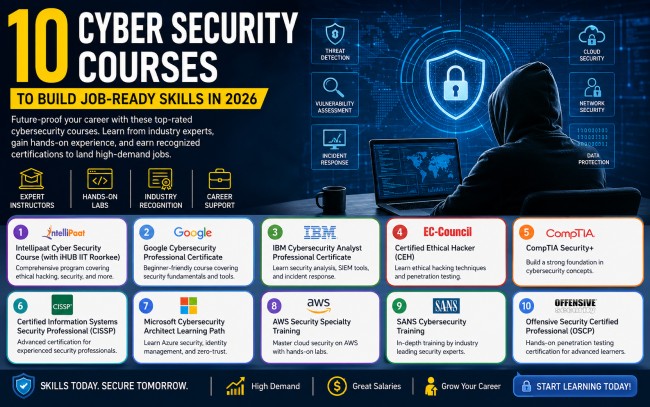
Cybersecurity is no longer just an IT concern—it’s a business priority. As organizations continue to embrace cloud computing, artificial intelligence (AI), remote work, and connected devices, the number and sophistication of cyber threats have increased significantly. This has created a growing demand for professionals who can secure digital infrastructure, identify vulnerabilities, and respond to security incidents.
Whether you’re a recent graduate, an IT professional looking to specialize, or someone planning a career switch, enrolling in a cybersecurity course can help you develop practical, job-ready skills. The best programs combine theoretical knowledge with hands-on labs, real-world projects, and industry-recognized certifications to prepare learners for today’s security challenges.
In this article, we’ve rounded up 10 cybersecurity courses that can help you build job-ready skills in 2026.
How We Selected These Courses
The courses featured in this list were chosen based on the following criteria:
- Industry-relevant curriculum
- Hands-on labs and practical projects
- Instructor expertise
- Industry recognition
- Flexibility for working professionals
- Career support and mentorship
- Coverage of current cybersecurity trends
1. Intellipaat Cyber Security Course (in Collaboration with iHUB IIT Roorkee).
The Cyber Security Course Program by Intellipaat, offered in collaboration with iHUB IIT Roorkee and aligned with EC-Council standards, is designed to prepare learners for real-world cybersecurity roles. The program follows a structured learning path that begins with networking and Linux fundamentals before progressing to advanced topics such as ethical hacking, penetration testing, vulnerability assessment, security and risk management, cryptography, cloud security, digital forensics, and information security. Learners also prepare for globally recognized certifications, including the Certified Ethical Hacker (CEH).
The curriculum emphasizes practical learning through 168+ hours of live online training, 60+ live instructor-led sessions, 25+ real-world cybersecurity projects, and hands-on assessments that simulate enterprise security environments. Participants receive guidance from IIT faculty, EC-Council Certified Trainers, and experienced industry professionals, helping them develop practical skills in threat detection, incident response, vulnerability analysis, and secure application development. The program also includes career services such as mentorship, resume-building assistance, mock interviews, and 100% placement assistance, making it an excellent choice for aspiring cybersecurity professionals and working professionals looking to upskill.
Best For: Beginners, IT professionals, software engineers, network administrators, and aspiring cybersecurity analysts
2. Google Cybersecurity Professional Certificate
Google’s Cybersecurity Professional Certificate provides a beginner-friendly pathway into cybersecurity. The program introduces networking, Linux, Python, SQL, security operations, risk management, and incident detection through practical exercises and interactive labs.
Its structured learning approach makes it suitable for individuals with little or no prior cybersecurity experience.
Best For: Career changers and beginners.
3. IBM Cybersecurity Analyst Professional Certificate
IBM’s professional certificate focuses on cybersecurity fundamentals, network security, endpoint protection, SIEM tools, incident response, and threat analysis.
Learners complete guided labs and practical assignments designed to simulate real-world security operations.
Best For: Entry-level cybersecurity professionals.
4. EC-Council Certified Ethical Hacker (CEH)
The Certified Ethical Hacker (CEH) program is one of the most recognized ethical hacking certifications worldwide. It covers penetration testing, vulnerability assessment, reconnaissance, malware threats, cryptography, web application security, and network security.
Many training providers supplement the curriculum with hands-on labs and simulated attack environments.
Best For: Professionals pursuing ethical hacking careers.
5. CompTIA Security+
CompTIA Security+ is a vendor-neutral certification that provides a solid understanding of cybersecurity concepts, including network security, identity management, risk assessment, cryptography, cloud security, and compliance.
It is widely recognized by employers and serves as an excellent foundation for advanced cybersecurity certifications.
Best For: Beginners and IT support professionals.
6. Certified Information Systems Security Professional (CISSP)
CISSP is one of the most respected certifications for experienced cybersecurity professionals. The program focuses on security architecture, governance, asset security, identity management, software development security, and risk management.
It is particularly valuable for professionals moving into senior or leadership roles.
Best For: Experienced security professionals.
7. Microsoft Cybersecurity Architect Learning Path
Microsoft’s learning path introduces Azure security, identity management, cloud governance, zero-trust architecture, and threat protection.
Professionals working in Microsoft cloud environments can gain practical knowledge through guided labs and hands-on exercises.
Best For: Cloud security professionals.
8. AWS Security Learning Path
AWS provides specialized security training covering Identity and Access Management (IAM), network security, encryption, monitoring, logging, compliance, and cloud security best practices.
The learning path prepares professionals for securing workloads within AWS cloud environments.
Best For: Cloud engineers and AWS administrators.
9. SANS Cyber Security Training
SANS Institute is recognized for its intensive cybersecurity training programs focused on penetration testing, digital forensics, incident response, malware analysis, and security operations.
The courses emphasize hands-on learning through practical labs and real-world security scenarios.
Best For: Intermediate and advanced cybersecurity professionals.
10. Offensive Security Certified Professional (OSCP)
OSCP is considered one of the most challenging penetration testing certifications available. Instead of relying on theory, learners spend most of their time solving practical hacking challenges in dedicated lab environments.
The certification is highly valued by employers hiring penetration testers and offensive security specialists.
Best For: Experienced ethical hackers and penetration testers.
Course Comparison
| Course | Practical Labs | Certification | Best For |
| Intellipaat Cyber Security Course | ✔ Extensive | Professional Certificate | Beginners & Professionals |
| Google Cybersecurity Professional Certificate | ✔ | Beginners | |
| IBM Cybersecurity Analyst | ✔ | IBM | Entry-Level Professionals |
| CEH | ✔ | EC-Council | Ethical Hackers |
| CompTIA Security+ | ✔ | CompTIA | Beginners |
| CISSP | Moderate | ISC² | Senior Professionals |
| Microsoft Cybersecurity Learning Path | ✔ | Microsoft | Azure Professionals |
| AWS Security Learning Path | ✔ | AWS | Cloud Engineers |
| SANS Cyber Security Training | ✔ Extensive | GIAC | Advanced Learners |
| OSCP | ✔ Intensive Labs | Offensive Security | Penetration Testers |
Skills You’ll Build
A quality cybersecurity course should help you develop practical skills in:
- Network security
- Linux administration
- Ethical hacking
- Vulnerability assessment
- Penetration testing
- Cloud security
- Identity and access management
- Security monitoring
- Digital forensics
- Incident response
- Risk management
- Security compliance
These competencies are highly valued across industries and can help prepare you for technical security roles.
Career Opportunities
After completing a cybersecurity course, you can pursue roles such as:
- Cybersecurity Analyst
- Security Operations Center (SOC) Analyst
- Ethical Hacker
- Penetration Tester
- Information Security Analyst
- Cloud Security Engineer
- Incident Response Analyst
- Security Consultant
- Vulnerability Assessment Analyst
- Network Security Engineer
As you gain experience, opportunities may also open up in security architecture, governance, and cybersecurity leadership.
How to Choose the Right Cybersecurity Course
When evaluating cybersecurity programs, consider the following:
- Does the curriculum match your career goals?
- Are there practical labs and real-world projects?
- Is the certification recognized by employers?
- Does the provider offer mentorship or career guidance?
- Can the course fit around your work or study schedule?
Selecting a course with a balance of theoretical knowledge and practical experience will provide better long-term value.
Frequently Asked Questions
1. Which cybersecurity course is best for beginners?
Beginner-friendly programs such as the Intellipaat Cyber Security Course, Google Cybersecurity Professional Certificate, IBM Cybersecurity Analyst Professional Certificate, and CompTIA Security+ provide a solid foundation for learners new to the field.
2. Is cybersecurity a good career in 2026?
Yes. Organizations across every industry continue to invest in cybersecurity, creating strong demand for professionals with practical security skills.
3. Do I need programming knowledge to learn cybersecurity?
No. Many beginner-level courses start with networking, operating systems, and cybersecurity fundamentals before introducing scripting and automation concepts.
4. How long does it take to complete a cybersecurity course?
Depending on the provider, courses typically range from a few weeks to several months. Advanced certifications may require additional preparation.
5. Are online cybersecurity certifications recognized by employers?
Yes. Certifications from reputable training providers and industry organizations are widely recognized, especially when supported by practical projects and hands-on experience.
Final Thoughts
Cybersecurity is one of the fastest-growing technology domains, and professionals with practical, job-ready skills are increasingly valuable to organizations worldwide. Choosing the right training program can help you build a strong technical foundation, gain hands-on experience, and prepare for a wide range of cybersecurity roles.
Among the programs highlighted above, the Intellipaat Cyber Security programs stands out for its comprehensive curriculum, live instructor-led training, practical labs, real-world projects, and career support. Other respected options, including Google Cybersecurity Professional Certificate, IBM Cybersecurity Analyst, CEH, CompTIA Security+, CISSP, Microsoft, AWS, SANS, and OSCP—also provide excellent learning opportunities depending on your experience level and career objectives.
Before enrolling, compare each program’s curriculum, practical exposure, certification value, and career services to select the course that best aligns with your professional goals and learning preferences.